Rhyton terminating in the forepart of a ram ca. 5th century B.C. Achaemenid This silver vessel is called a rhyton’ (from the Greek rheo, meaning flow through’) by scholars because it has a spout at the bottom. Like many rhyta, it consists of a horn-shaped beaker and a hollow sculptural element, in this case in the form of the foreparts of a kneeling ram or ibex. The ibex has curved horns, pointed ears, heavy brows, a narrow snout and a chin beard. Rows of spiral curls on its chest and back indicate hair or possibly fleece. The animal’s hindquarters are depicted in row relief on the beaker itself, with its hind legs running straight up the side. A feather is engraved on each of the ibex’s flanks, perhaps suggesting wings. The beaker is decorated with horizontal fluting. Below the outturned rim is a repeating pattern of engraved lotuses and palmettes, separated from the fluting by a guilloche border. The two parts of the rhyton are now joined by an acrylic ring and it is not certain th
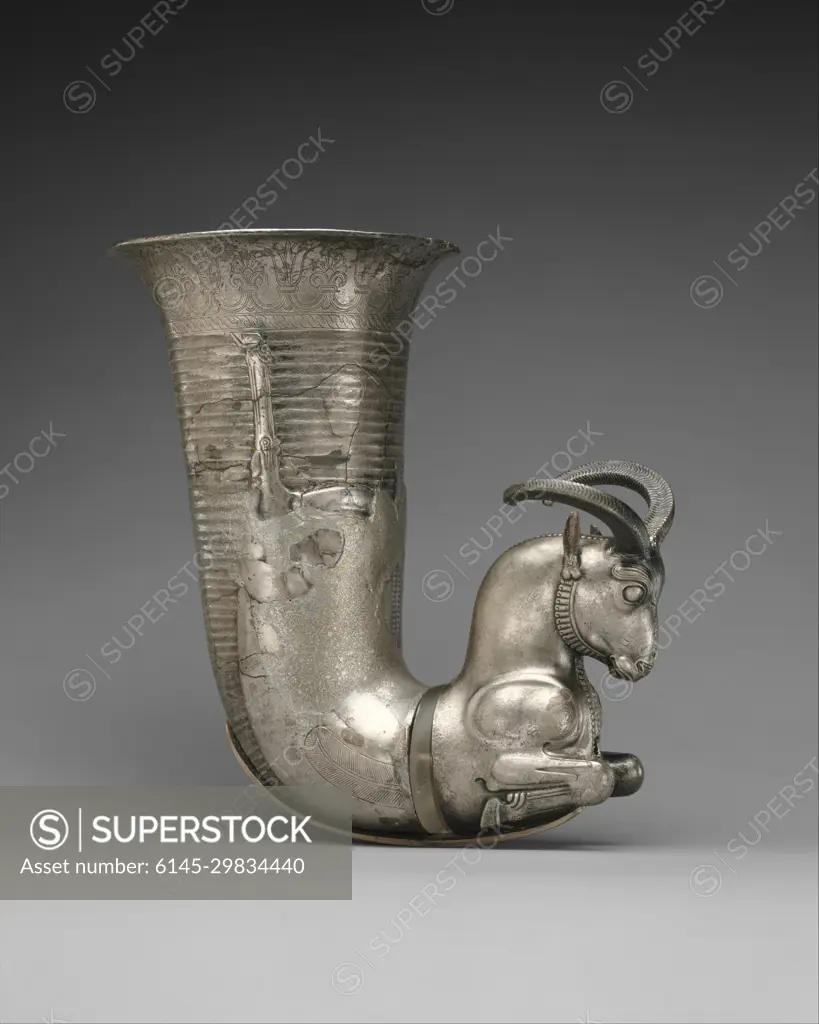
SuperStock offers millions of photos, videos, and stock assets to creatives around the world. This image of Rhyton terminating in the forepart of a ram ca. 5th century B.C. Achaemenid This silver vessel is called a rhyton’ (from the Greek rheo, meaning flow through’) by scholars because it has a spout at the bottom. Like many rhyta, it consists of a horn-shaped beaker and a hollow sculptural element, in this case in the form of the foreparts of a kneeling ram or ibex. The ibex has curved horns, pointed ears, heavy brows, a narrow snout and a chin beard. Rows of spiral curls on its chest and back indicate hair or possibly fleece. The animal’s hindquarters are depicted in row relief on the beaker itself, with its hind legs running straight up the side. A feather is engraved on each of the ibex’s flanks, perhaps suggesting wings. The beaker is decorated with horizontal fluting. Below the outturned rim is a repeating pattern of engraved lotuses and palmettes, separated from the fluting by a guilloche border. The two parts of the rhyton are now joined by an acrylic ring and it is not certain th by Piemags/PL Photography Limited is available for licensing today.
Looking for a license?
Click here, and we'll help you find it! Questions? Just ask!
Click here, and we'll help you find it! Questions? Just ask!
DETAILS
Image Number: 6145-29834440Royalty FreeCredit Line:Piemags/PL Photography Limited/SuperStockCollection:PL Photography Limited Contributor:Piemags Model Release:NoProperty Release:NoResolution:2978×3722