Record of a haiku exchange on kaishi writing paper second half of the 17th century Matsuo Bash This sheet of kaishi writing paper is inscribed with verse by Japan’s most famous haiku poet, Matsuo Bash, and one of his pupils in the teacher’s own handwriting. When this work was first publically displayed at Seattle Asian Art Museum in 2015, it created a small sensation among literary specialists in Japan because not only were the Bash poems recorded here previously unknown, the work must date to relatively early in his career as a poet, before he turned forty. In the West, it would be the equivalent of discovering a manuscript with previously unpublished poems by (Bash’s contemporary) John Milton in his own hand. At the time of the discovery, the Bash expert Professor Tamaki Tsukasa stated that the handwriting, seal, and signature could also be authenticated as genuine, keeping in mind that forgeries of Bash manuscripts abound (for instance, The Met has one in its collection). The
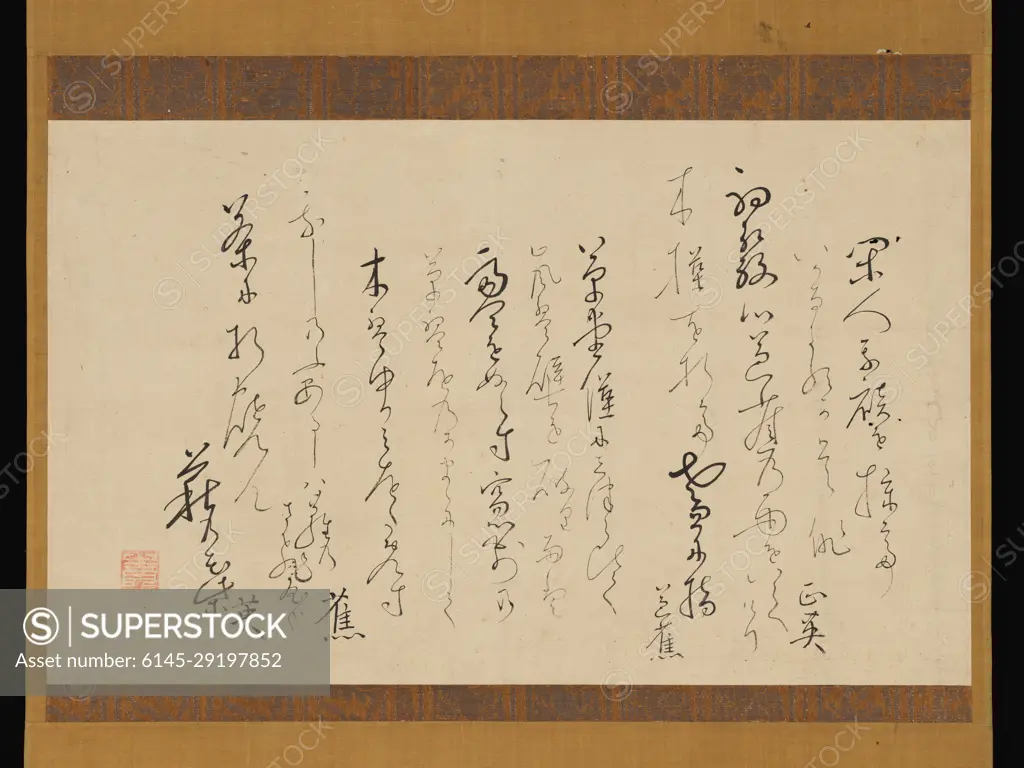
SuperStock offers millions of photos, videos, and stock assets to creatives around the world. This image of Record of a haiku exchange on kaishi writing paper second half of the 17th century Matsuo Bash This sheet of kaishi writing paper is inscribed with verse by Japan’s most famous haiku poet, Matsuo Bash, and one of his pupils in the teacher’s own handwriting. When this work was first publically displayed at Seattle Asian Art Museum in 2015, it created a small sensation among literary specialists in Japan because not only were the Bash poems recorded here previously unknown, the work must date to relatively early in his career as a poet, before he turned forty. In the West, it would be the equivalent of discovering a manuscript with previously unpublished poems by (Bash’s contemporary) John Milton in his own hand. At the time of the discovery, the Bash expert Professor Tamaki Tsukasa stated that the handwriting, seal, and signature could also be authenticated as genuine, keeping in mind that forgeries of Bash manuscripts abound (for instance, The Met has one in its collection). The by Piemags/PL Photography Limited is available for licensing today.
Looking for a license?
Click here, and we'll help you find it! Questions? Just ask!
Click here, and we'll help you find it! Questions? Just ask!
DETAILS
Image Number: 6145-29197852Royalty FreeCredit Line:Piemags/PL Photography Limited/SuperStockCollection:PL Photography Limited Contributor:Piemags Model Release:NoProperty Release:NoResolution:4000×3003