Reclining mouflon ca. 2600-1900 B.C. Indus This powerful sculpture represents a mouflon, a type of wild sheep native to the highland regions of the Near East. The animal's head, now partially broken away, is held upward and is twisted to the right, creating an impression of alertness. The artist has achieved a realistic rendering of an animal at rest, its weight thrown fully onto its left haunch, and its left hind leg tucked under its body. The bottom of the statue has been worn away, but it is likely that the hidden leg was originally indicated there. The entire body is contained within a single unbroken outline. The horns, ears, tail, and muscles were modeled in relief, although time and secondary use have flattened the contours on the right side. This combination of closed outline with broadly modeled masses and a minimum of incised detail is characteristic of animal sculpture from the Harappan-period levels at the site of Mohenjo Daro in the lower reaches of the Indus River. The fu
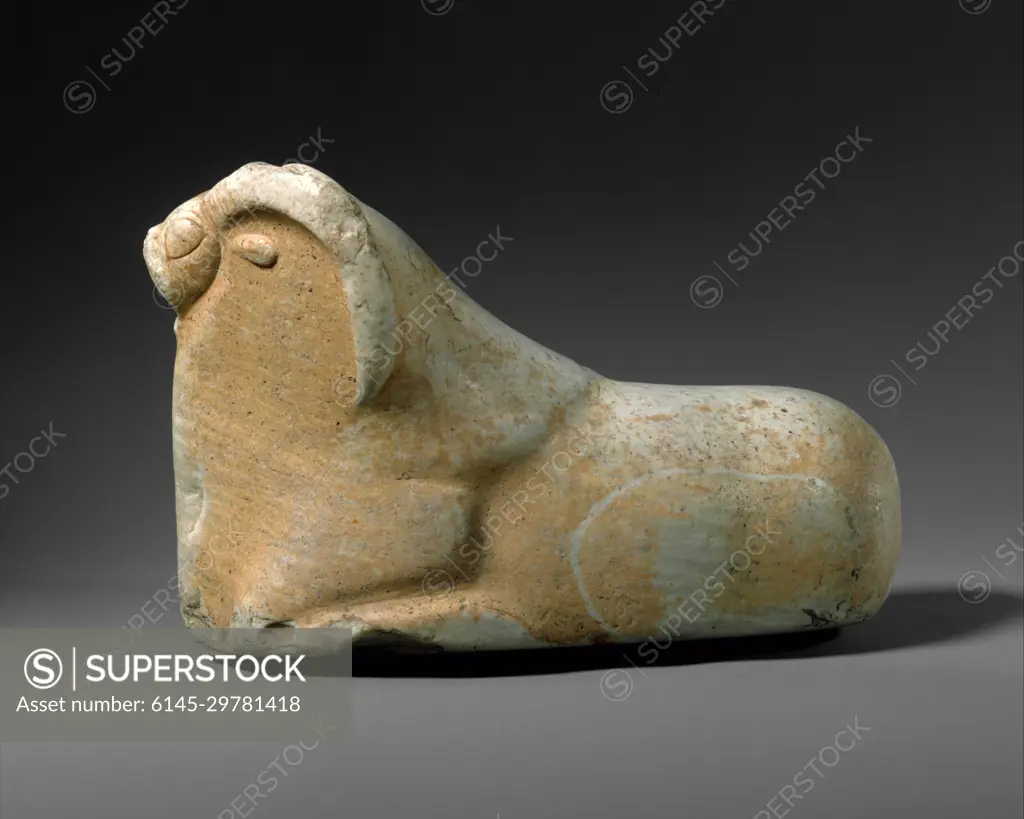
SuperStock offers millions of photos, videos, and stock assets to creatives around the world. This image of Reclining mouflon ca. 2600-1900 B.C. Indus This powerful sculpture represents a mouflon, a type of wild sheep native to the highland regions of the Near East. The animal's head, now partially broken away, is held upward and is twisted to the right, creating an impression of alertness. The artist has achieved a realistic rendering of an animal at rest, its weight thrown fully onto its left haunch, and its left hind leg tucked under its body. The bottom of the statue has been worn away, but it is likely that the hidden leg was originally indicated there. The entire body is contained within a single unbroken outline. The horns, ears, tail, and muscles were modeled in relief, although time and secondary use have flattened the contours on the right side. This combination of closed outline with broadly modeled masses and a minimum of incised detail is characteristic of animal sculpture from the Harappan-period levels at the site of Mohenjo Daro in the lower reaches of the Indus River. The fu by Piemags/PL Photography Limited is available for licensing today.
Looking for a license?
Click here, and we'll help you find it! Questions? Just ask!
Click here, and we'll help you find it! Questions? Just ask!
DETAILS
Image Number: 6145-29781418Royalty FreeCredit Line:Piemags/PL Photography Limited/SuperStockCollection:PL Photography Limited Contributor:Piemags Model Release:NoProperty Release:NoResolution:3793×3037