Problem XXIIII: A Machine for a Moveable Galatea in a Grotto, in: Les Raisons des Forces Mouvantes, plate 32 1615 Designed by Salomon de Caus Salomon de Caus (1576-1626) was a unique figure in garden history. Trained as an architect-mathematician and hydraulic engineer, he was renowned not only for his garden designs with magnificent waterworks, but also for his many publications on topics relating to the arts and sciences. His most influential works include the Hortus Palatinus (1620) on his Heidelberg garden designs, and Les raisons des forces mouvantes (1615), setting out the principles of hydraulics on which the automata or trick fountains and water jokes in the seventeenth-century garden were based. Familiar with the waterworks in Italian Renaissance gardens (Villa d'Este, Tivoli, and Pratolino, Florence), ultimately derived from the just reissued works of Hero of Alexandria (first century A.D.), de Caus introduced hydraulics into the Northern European garden. His influence was wi
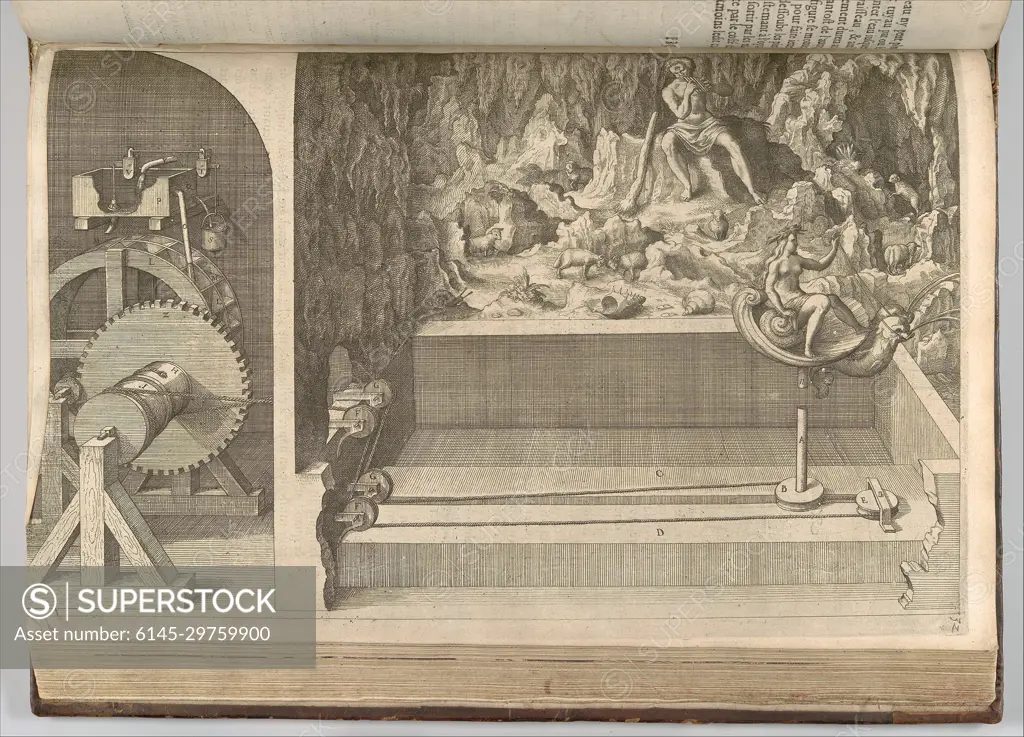
SuperStock offers millions of photos, videos, and stock assets to creatives around the world. This image of Problem XXIIII: A Machine for a Moveable Galatea in a Grotto, in: Les Raisons des Forces Mouvantes, plate 32 1615 Designed by Salomon de Caus Salomon de Caus (1576-1626) was a unique figure in garden history. Trained as an architect-mathematician and hydraulic engineer, he was renowned not only for his garden designs with magnificent waterworks, but also for his many publications on topics relating to the arts and sciences. His most influential works include the Hortus Palatinus (1620) on his Heidelberg garden designs, and Les raisons des forces mouvantes (1615), setting out the principles of hydraulics on which the automata or trick fountains and water jokes in the seventeenth-century garden were based. Familiar with the waterworks in Italian Renaissance gardens (Villa d'Este, Tivoli, and Pratolino, Florence), ultimately derived from the just reissued works of Hero of Alexandria (first century A.D.), de Caus introduced hydraulics into the Northern European garden. His influence was wi by Piemags/PL Photography Limited is available for licensing today.
Looking for a license?
Click here, and we'll help you find it! Questions? Just ask!
Click here, and we'll help you find it! Questions? Just ask!
DETAILS
Image Number: 6145-29759900Royalty FreeCredit Line:Piemags/PL Photography Limited/SuperStockCollection:PL Photography Limited Contributor:Piemags Model Release:NoProperty Release:NoResolution:1937×1396