The Princess Dwells in the Oak Tree Where ye Wild Pigeons Come to Feed Her, for "The Wonder Clock" 1887 Howard Pyle American Pyle is considered the father of American illustration. Born in Wilmington, Delaware, he became interested in art and writing as a boy, studied in Philadelphia and then New York, at the Art Students League. In 1878, a drawing accepted by Harper's Weekly helped to launch his career and the artist returned to Delaware in 1880. Over the next three decades Pyle wrote and illustrated a series of now iconic works and became an influential teacher. Aware of contemporary European innovations, he skillfully adapted his style to suit a range of subjects. This design first appeared in Harper's "Young People," May 25, 1886 titled "The Princess and the Pigeons," and was used to illustrate the story "Mother Hildegarde." Here, the artist redrew it for "The Wonder Clock," a book published by Harper Brothers in 1888. The related image appears in story XV on page 197.. The Princes
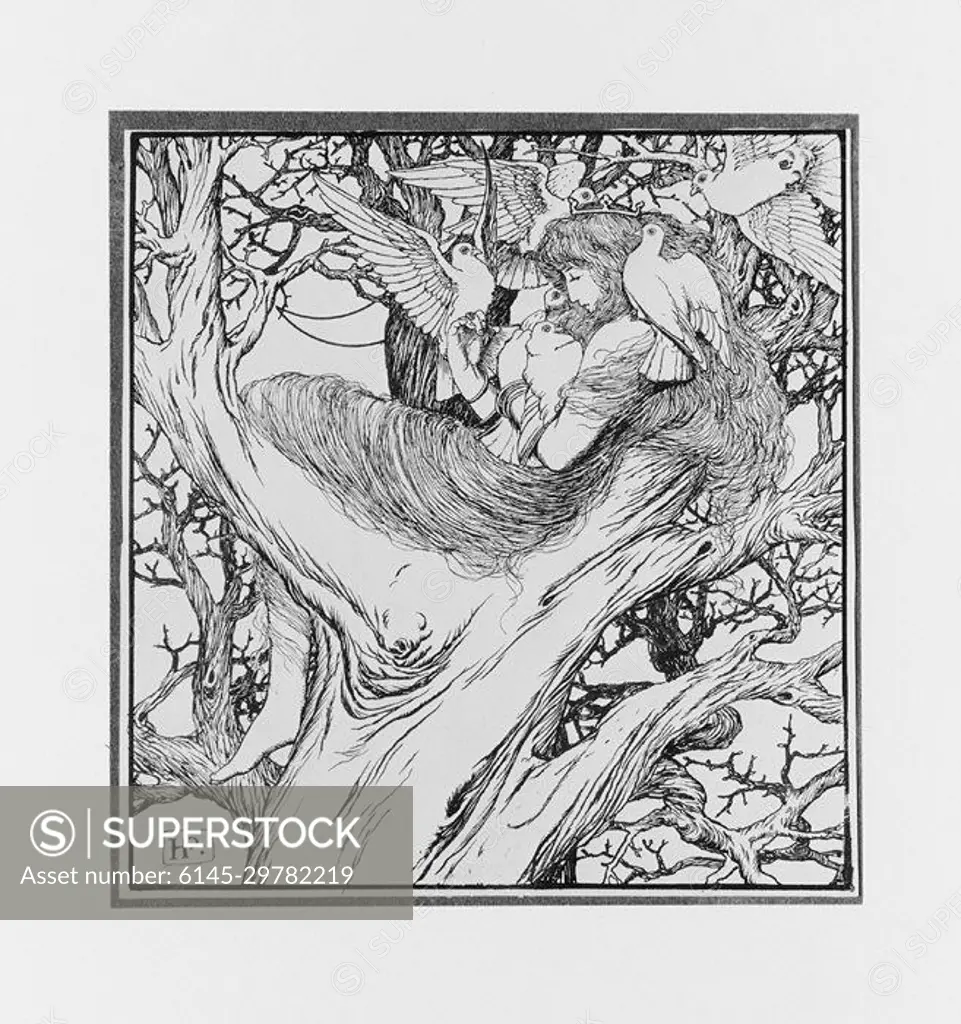
SuperStock offers millions of photos, videos, and stock assets to creatives around the world. This image of The Princess Dwells in the Oak Tree Where ye Wild Pigeons Come to Feed Her, for "The Wonder Clock" 1887 Howard Pyle American Pyle is considered the father of American illustration. Born in Wilmington, Delaware, he became interested in art and writing as a boy, studied in Philadelphia and then New York, at the Art Students League. In 1878, a drawing accepted by Harper's Weekly helped to launch his career and the artist returned to Delaware in 1880. Over the next three decades Pyle wrote and illustrated a series of now iconic works and became an influential teacher. Aware of contemporary European innovations, he skillfully adapted his style to suit a range of subjects. This design first appeared in Harper's "Young People," May 25, 1886 titled "The Princess and the Pigeons," and was used to illustrate the story "Mother Hildegarde." Here, the artist redrew it for "The Wonder Clock," a book published by Harper Brothers in 1888. The related image appears in story XV on page 197.. The Princes by Piemags/PL Photography Limited is available for licensing today.
Looking for a license?
Click here, and we'll help you find it! Questions? Just ask!
Click here, and we'll help you find it! Questions? Just ask!
DETAILS
Image Number: 6145-29782219Royalty FreeCredit Line:Piemags/PL Photography Limited/SuperStockCollection:PL Photography Limited Contributor:Piemags Model Release:NoProperty Release:NoResolution:657×700