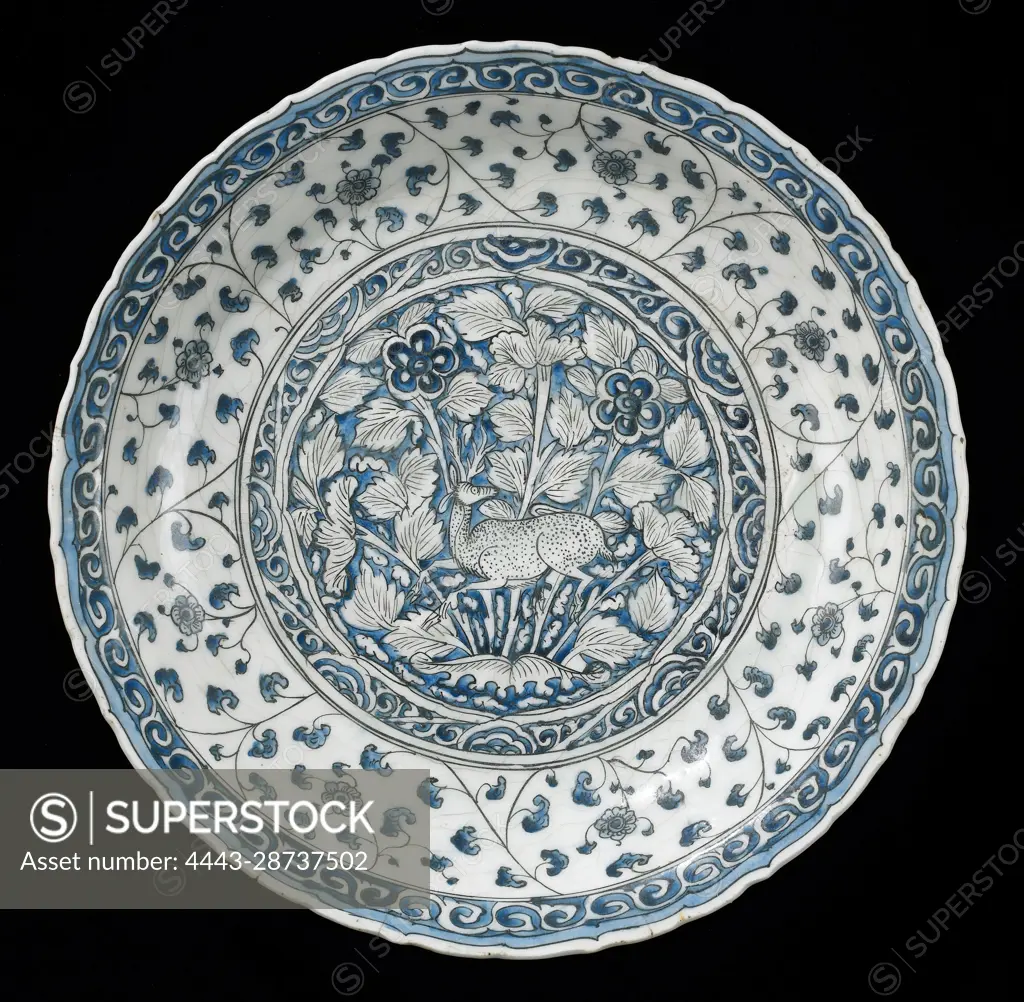
Plate, early 18th century, 2 1/2 x 15 1/2 in. (6.35 x 39.37 cm), White earthenware with underglaze blue and black decor, Meshed ware, Iran, 18th century, Although blue-and-white patterns in ceramics are associated with China, Islamic potters were the first to use cobalt-blue decoration. When commercial ties to China were reestablished during the 1300s, fine ceramics imported from East Asia, particularly blue-and-white, became extremely popular and greatly affected subsequent Islamic styles. This outstanding example from the Safavid period is closely related to Chinese porcelains of the Ming dynasty (1368-1644). The foliate rim, tendril design of the cavetto (concave molding), animal motif in the center, and continuous scroll bands all loosely refer to Chinese motifs.
SuperStock offers millions of photos, videos, and stock assets to creatives around the world. This image of Plate, early 18th century, 2 1/2 x 15 1/2 in. (6.35 x 39.37 cm), White earthenware with underglaze blue and black decor, Meshed ware, Iran, 18th century, Although blue-and-white patterns in ceramics are associated with China, Islamic potters were the first to use cobalt-blue decoration. When commercial ties to China were reestablished during the 1300s, fine ceramics imported from East Asia, particularly blue-and-white, became extremely popular and greatly affected subsequent Islamic styles. This outstanding example from the Safavid period is closely related to Chinese porcelains of the Ming dynasty (1368-1644). The foliate rim, tendril design of the cavetto (concave molding), animal motif in the center, and continuous scroll bands all loosely refer to Chinese motifs. by Artokoloro is available for licensing today.
Looking for a license?
Click here, and we'll help you find it! Questions? Just ask!
Click here, and we'll help you find it! Questions? Just ask!
DETAILS
Image Number: 4443-28737502Rights ManagedCredit Line:Artokoloro/SuperStockCollection:Artokoloro Model Release:NoProperty Release:NoResolution:4182×4095