Plaque 12th century This small pentagonal ivory plaque depicts a lion set against foliage. With one paw raised, the lion tilts its head upwards, and its tail swings back towards the head. The craftsman has carved lines on the body to indicate fur and patterning, and holes bored into the surface may originally have been set with stones. Depictions of animal forms within framing devices were common decorative motifs in objects produced around the Mediterranean in the medieval period, and can be found ornamenting wood, textiles, ivory, metalwork and ceramics. This piece is one of a pair in the collection of The Metropolitan Museum of Art, with 67.204.2. The iconography of these plaques suggest they may be a derivative of depictions of the four Christian evangelists; here it could be a representation of Mark, whose symbol is a lion.. Plaque. 12th century. Bone; carved and incised. Made in Italy, Sicily. Ivories and Bone
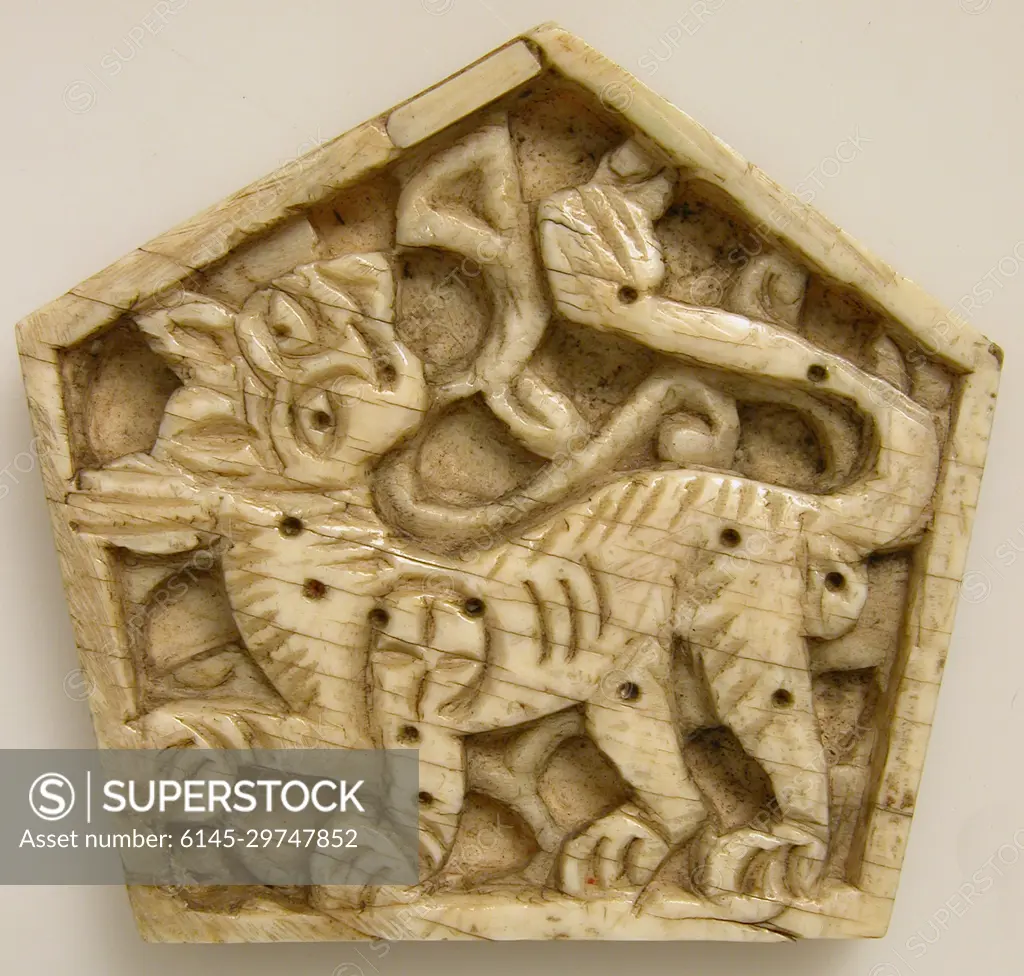
SuperStock offers millions of photos, videos, and stock assets to creatives around the world. This image of Plaque 12th century This small pentagonal ivory plaque depicts a lion set against foliage. With one paw raised, the lion tilts its head upwards, and its tail swings back towards the head. The craftsman has carved lines on the body to indicate fur and patterning, and holes bored into the surface may originally have been set with stones. Depictions of animal forms within framing devices were common decorative motifs in objects produced around the Mediterranean in the medieval period, and can be found ornamenting wood, textiles, ivory, metalwork and ceramics. This piece is one of a pair in the collection of The Metropolitan Museum of Art, with 67.204.2. The iconography of these plaques suggest they may be a derivative of depictions of the four Christian evangelists; here it could be a representation of Mark, whose symbol is a lion.. Plaque. 12th century. Bone; carved and incised. Made in Italy, Sicily. Ivories and Bone by Piemags/PL Photography Limited is available for licensing today.
Looking for a license?
Click here, and we'll help you find it! Questions? Just ask!
Click here, and we'll help you find it! Questions? Just ask!
DETAILS
Image Number: 6145-29747852Royalty FreeCredit Line:Piemags/PL Photography Limited/SuperStockCollection:PL Photography Limited Contributor:Piemags Model Release:NoProperty Release:NoResolution:1848×1763