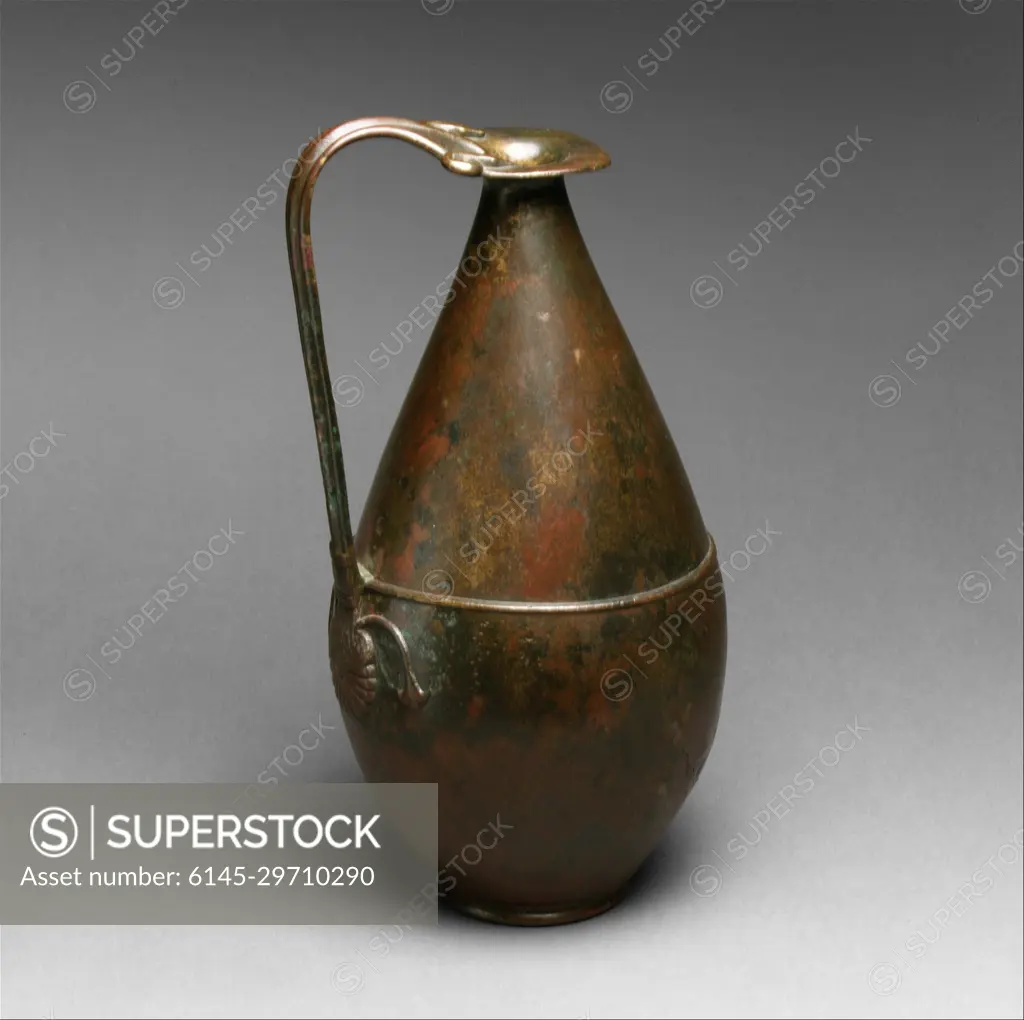
Phoenician-style ewer ca. 7th-6th century B.C. Vessels of similar form and construction have been excavated in Cyprus, Italy, and the Iberian Peninsula, with related ceramic examples from Cyprus and the Levant. The piriform shape of this vessel is divided into two sections by a narrow raised band. The convex lower body rests on a hollow ring foot above which the elegant neck gradually tapers into a trefoil lip. A three-ridged handle spouts from a palmette with tendrils and attaches the lower body to the lip. At the top of the handle the three ridges transform into three snake heads, the central one of which extends directly into the vessel. The closest parallel to this ewer is an example from Niebla in Spain, at the Instituto de Valencia de Don Juan, Madrid, which has looped snake heads at the top of the handle.. Phoenician-style ewer. ca. 7th-6th century B.C.. Bronze. Iron Age. Iberian Peninsula
SuperStock offers millions of photos, videos, and stock assets to creatives around the world. This image of Phoenician-style ewer ca. 7th-6th century B.C. Vessels of similar form and construction have been excavated in Cyprus, Italy, and the Iberian Peninsula, with related ceramic examples from Cyprus and the Levant. The piriform shape of this vessel is divided into two sections by a narrow raised band. The convex lower body rests on a hollow ring foot above which the elegant neck gradually tapers into a trefoil lip. A three-ridged handle spouts from a palmette with tendrils and attaches the lower body to the lip. At the top of the handle the three ridges transform into three snake heads, the central one of which extends directly into the vessel. The closest parallel to this ewer is an example from Niebla in Spain, at the Instituto de Valencia de Don Juan, Madrid, which has looped snake heads at the top of the handle.. Phoenician-style ewer. ca. 7th-6th century B.C.. Bronze. Iron Age. Iberian Peninsula by Piemags/PL Photography Limited is available for licensing today.
Looking for a license?
Click here, and we'll help you find it! Questions? Just ask!
Click here, and we'll help you find it! Questions? Just ask!
DETAILS
Image Number: 6145-29710290Royalty FreeCredit Line:Piemags/PL Photography Limited/SuperStockCollection:PL Photography Limited Contributor:Piemags Model Release:NoProperty Release:NoResolution:1998×1991