Pendant in the form of a centaur late 16th-early 17th century possibly Spanish Baroque pearls provided a special challenge to the imagination of the Renaissance goldsmith. The rather difficult shape of this irregular pearl has been used in an ingenious way to suggest the hybrid form of the centaur, the half-human, half-equine creature of classical myth. The base of the jewel incorporates an earlier piece of gold filigree work in a lobed pattern associated with Hispano-Moresque design. In addition, although reenameled, it displays traces of the dull enameled colors used by Hispano-Moresque goldsmiths. The jewel-decorated band on the side of the base, the chains, and the canopy from which the chains are suspended are later additions.. Pendant in the form of a centaur. possibly Spanish. late 16th-early 17th century. Baroque pearl with enameled gold mounts set with sapphires and rubies, and with pendent pearls
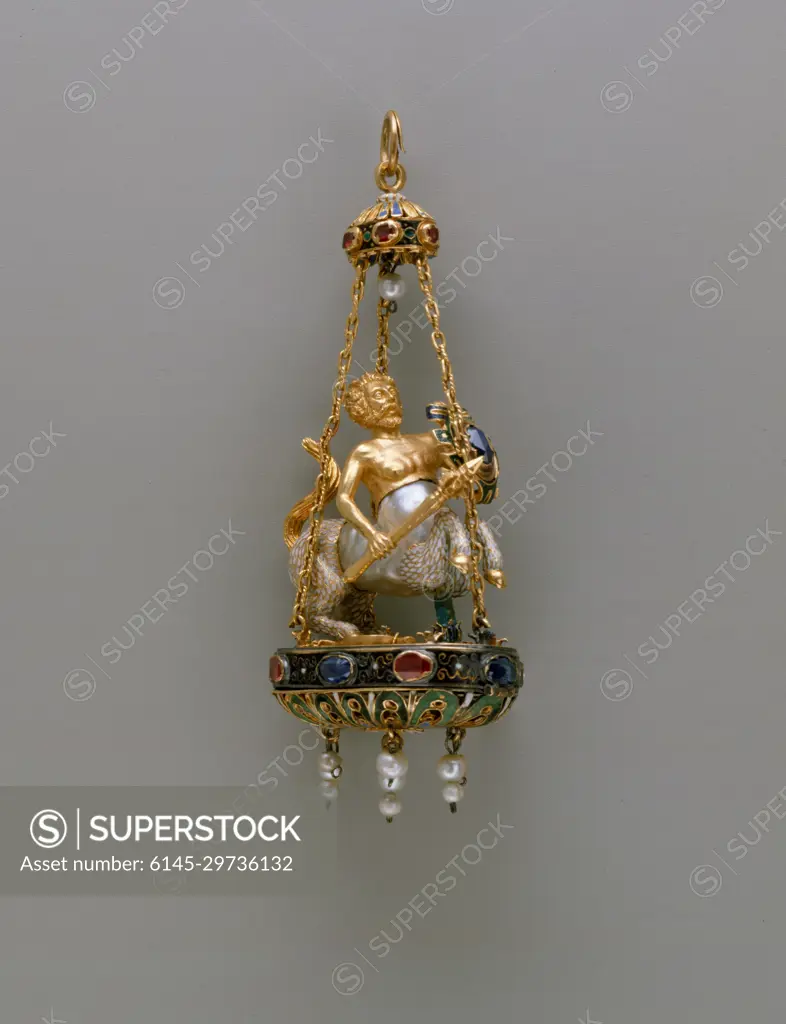
SuperStock offers millions of photos, videos, and stock assets to creatives around the world. This image of Pendant in the form of a centaur late 16th-early 17th century possibly Spanish Baroque pearls provided a special challenge to the imagination of the Renaissance goldsmith. The rather difficult shape of this irregular pearl has been used in an ingenious way to suggest the hybrid form of the centaur, the half-human, half-equine creature of classical myth. The base of the jewel incorporates an earlier piece of gold filigree work in a lobed pattern associated with Hispano-Moresque design. In addition, although reenameled, it displays traces of the dull enameled colors used by Hispano-Moresque goldsmiths. The jewel-decorated band on the side of the base, the chains, and the canopy from which the chains are suspended are later additions.. Pendant in the form of a centaur. possibly Spanish. late 16th-early 17th century. Baroque pearl with enameled gold mounts set with sapphires and rubies, and with pendent pearls by Piemags/PL Photography Limited is available for licensing today.
Looking for a license?
Click here, and we'll help you find it! Questions? Just ask!
Click here, and we'll help you find it! Questions? Just ask!
DETAILS
Image Number: 6145-29736132Royalty FreeCredit Line:Piemags/PL Photography Limited/SuperStockCollection:PL Photography Limited Contributor:Piemags Model Release:NoProperty Release:NoResolution:3071×4000