Pear-Shaped Bottle with a Bullock Design second half 17th century Very few pieces of Iranian lusterware survive from the fifteenth and sixteenth centuries, but this technique was revived in the seventeenth century. During this period, lusterware was produced in a relatively limited range of shapes, including elegant bottles, such as the one here, as well as dishes, bowls, cups, ewers and sand-shakers. This bottle would have been made toward the end of the reign of Shah Abbas II (1642-1666), a period of heightened artistic activity in which new ideas from Europe and India found favor. Thus, the eclectic confluence of the Indian zebu bull, the Persian peacock, and the Chinese deer on one bottle would have been admired as much as the elegant shape and lustrous glaze.. Pear-Shaped Bottle with a Bullock Design. second half 17th century. Stonepaste; luster-painted on opaque white glaze. Made in Iran. Ceramics
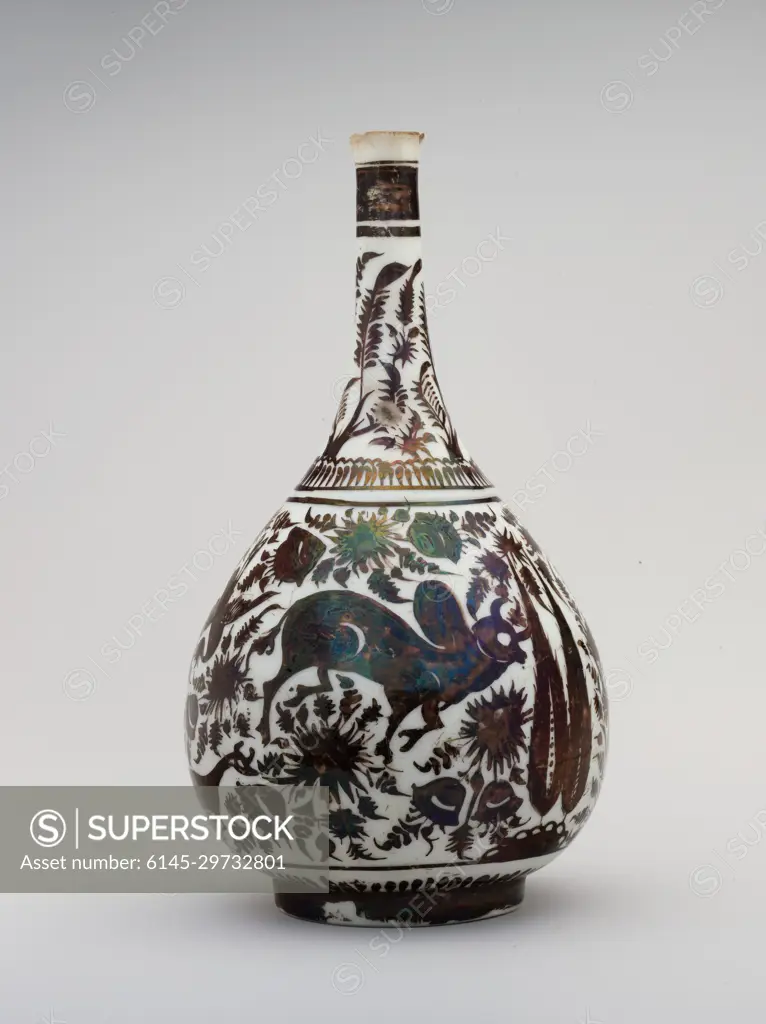
SuperStock offers millions of photos, videos, and stock assets to creatives around the world. This image of Pear-Shaped Bottle with a Bullock Design second half 17th century Very few pieces of Iranian lusterware survive from the fifteenth and sixteenth centuries, but this technique was revived in the seventeenth century. During this period, lusterware was produced in a relatively limited range of shapes, including elegant bottles, such as the one here, as well as dishes, bowls, cups, ewers and sand-shakers. This bottle would have been made toward the end of the reign of Shah Abbas II (1642-1666), a period of heightened artistic activity in which new ideas from Europe and India found favor. Thus, the eclectic confluence of the Indian zebu bull, the Persian peacock, and the Chinese deer on one bottle would have been admired as much as the elegant shape and lustrous glaze.. Pear-Shaped Bottle with a Bullock Design. second half 17th century. Stonepaste; luster-painted on opaque white glaze. Made in Iran. Ceramics by Piemags/PL Photography Limited is available for licensing today.
Looking for a license?
Click here, and we'll help you find it! Questions? Just ask!
Click here, and we'll help you find it! Questions? Just ask!
DETAILS
Image Number: 6145-29732801Royalty FreeCredit Line:Piemags/PL Photography Limited/SuperStockCollection:PL Photography Limited Contributor:Piemags Model Release:NoProperty Release:NoResolution:2995×4000