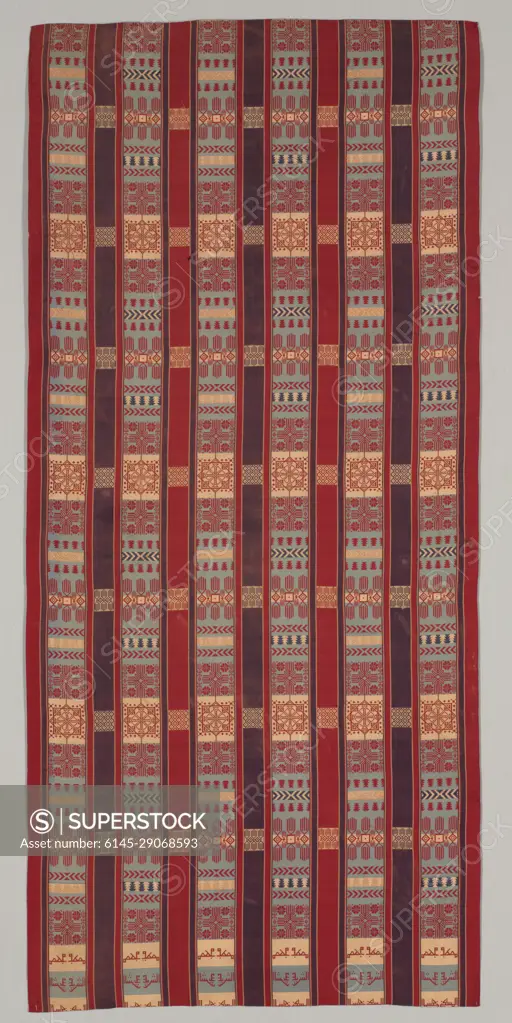
Panel from a Head Covering (ajar), probably 1800s or early 1900s. Africa, North Africa, Tunisia, probably Testour or Tunis, Tunisian weaver. Silk: plain cloth, brocaded; overall: 117.2 x 53.4 cm (46 1/8 x 21 in.). This panel was part of an urban Tunisian woman’s head-covering (ajar). Two such panels flanked a face-obscuring black panel. Such luxurious garments of seclusion were once reserved for elites. The decorative panels draped down when worn, showing off the finely woven motifs and demonstrating the wearer’s family wealth. Arranged in bands, motifs include stylized trees (or protective hands), flowers, eight-pointed stars, and geometric designs. The mirrored Kufic (squared Arabic script) lettering in teal is likely the name of the weaver or panel owner. Weavers with Muslim Andalusian (southern Spanish) heritage originally made these, drawing from Andalusian and Turkish motifs; later, workshops in Tunis produced them.
SuperStock offers millions of photos, videos, and stock assets to creatives around the world. This image of Explore the Intricate Beauty of Traditional Ardabil Iranian Textile Art with Geometric Patterns and Rich Colors by Piemags/PL Photography Limited is available for licensing today.
Looking for a license?
Click here, and we'll help you find it! Questions? Just ask!
Click here, and we'll help you find it! Questions? Just ask!
DETAILS
Image Number: 6145-29068593Royalty FreeCredit Line:Piemags/PL Photography Limited/SuperStockCollection:PL Photography Limited Contributor:Piemags Model Release:NoProperty Release:NoResolution:1702×3400