Pair of horns 1729 This pair of horns is of a transitional design that spans the instruments journey from the hunt to the orchestra. Although they could have been used in an outdoor context, they are representative of the more compact form of the horn that appeared with increasing frequency in orchestras in the first decades of the 18th century. It is likely that Handels horn players, most of whom hailed from Germany, would have played the Water Music on instruments similar to this. Made from brass and pitched in 16 foot D, this pair of horns is identical in all details of design and construction. The bell and mouthpiece receiver stays are fashioned of flat metal. The flange of the bell stay is cut in an elongated cup shape. The body tubing of the instruments is coiled 3 ½ times. The two horns are wound identically, with the mouthpiece receiver on the left-hand side of the tubing when the horns are held in playing position, thus the instruments are "right handed" (although they coul
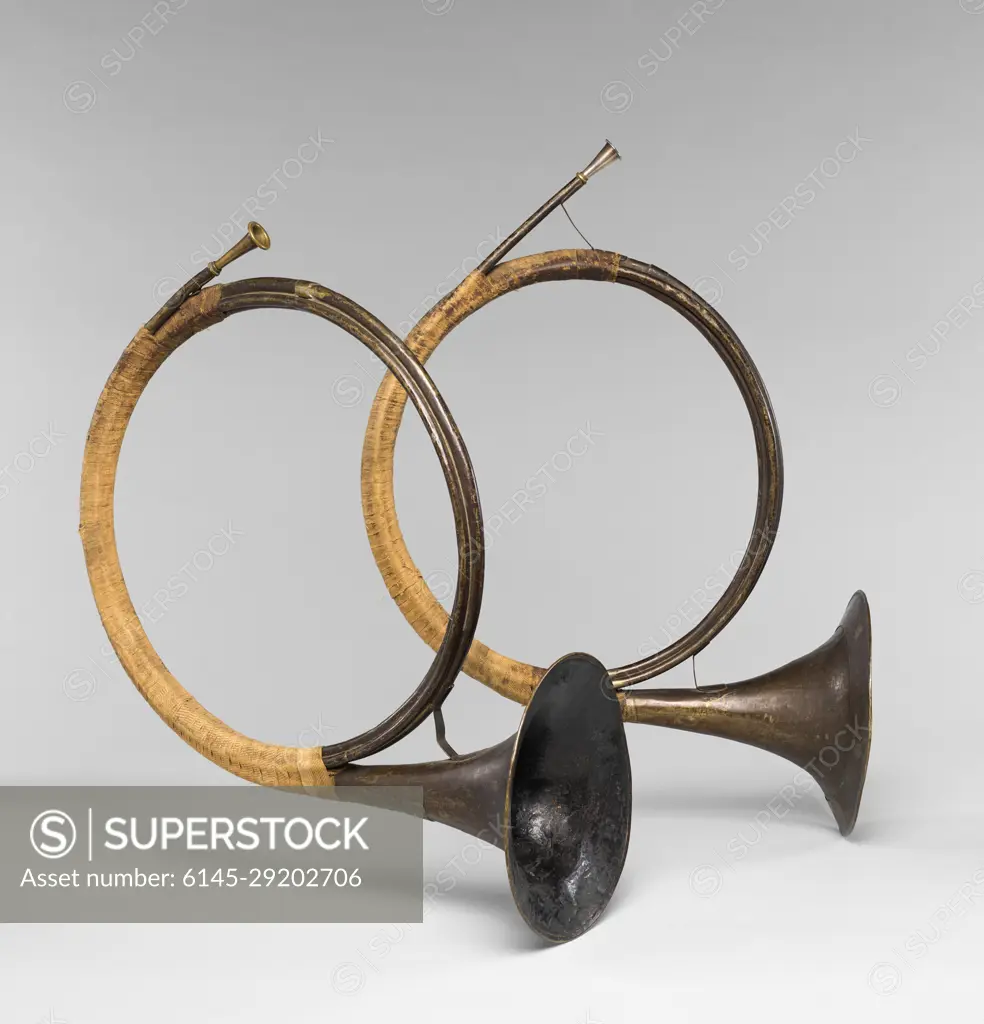
SuperStock offers millions of photos, videos, and stock assets to creatives around the world. This image of Pair of horns 1729 This pair of horns is of a transitional design that spans the instruments journey from the hunt to the orchestra. Although they could have been used in an outdoor context, they are representative of the more compact form of the horn that appeared with increasing frequency in orchestras in the first decades of the 18th century. It is likely that Handels horn players, most of whom hailed from Germany, would have played the Water Music on instruments similar to this. Made from brass and pitched in 16 foot D, this pair of horns is identical in all details of design and construction. The bell and mouthpiece receiver stays are fashioned of flat metal. The flange of the bell stay is cut in an elongated cup shape. The body tubing of the instruments is coiled 3 ½ times. The two horns are wound identically, with the mouthpiece receiver on the left-hand side of the tubing when the horns are held in playing position, thus the instruments are "right handed" (although they coul by Piemags/PL Photography Limited is available for licensing today.
Looking for a license?
Click here, and we'll help you find it! Questions? Just ask!
Click here, and we'll help you find it! Questions? Just ask!
DETAILS
Image Number: 6145-29202706Royalty FreeCredit Line:Piemags/PL Photography Limited/SuperStockCollection:PL Photography Limited Contributor:Piemags Model Release:NoProperty Release:NoResolution:3847×4000