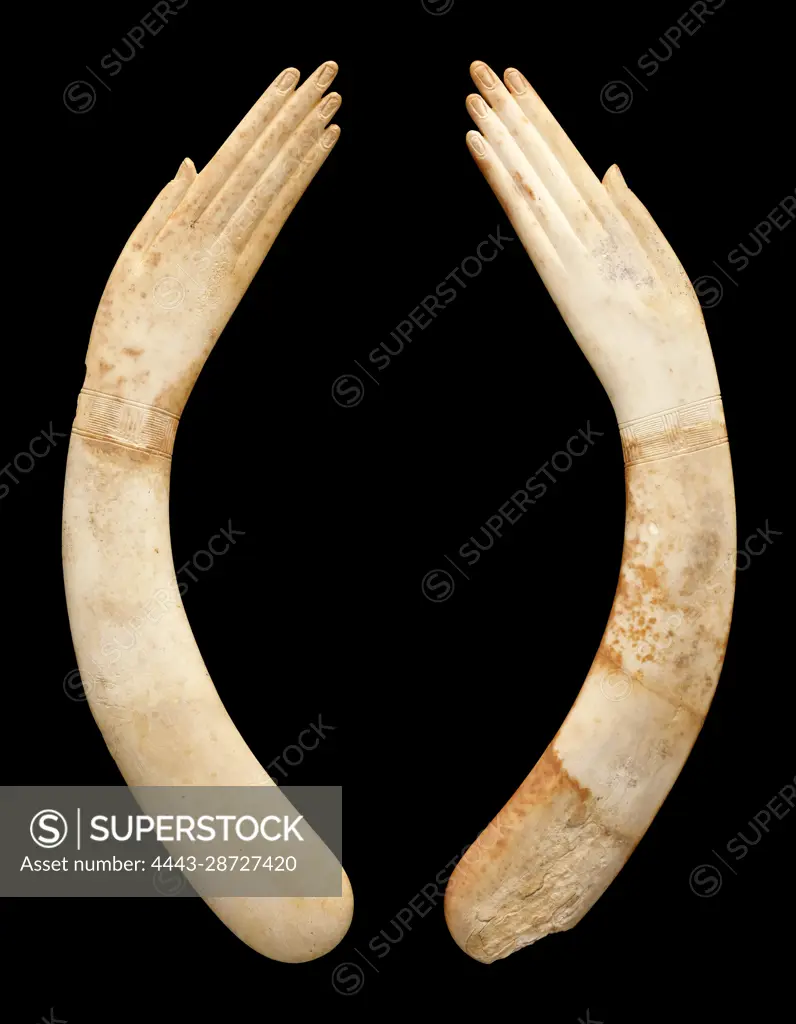
Pair of clappers, about 1550-1292 BCE, 9 9/16 x 3 x 7/16 in. (24.29 x 7.62 x 1.11 cm) (each, approx.), Hippopotamus ivory, Egypt, 16th-13th century BCE, These delicately carved forearms, found in a three-thousand-year-old ancient Egyptian tomb, are percussive instruments. Their curved shape and matching growth lines show that they were made from a single hippopotamus tusk, sawed down the middle into two equal pieces. Music was an important part of ceremonies and banquets in ancient Egypt, and the noise of clapping, banging, and rattling was thought to drive away hostile forces. While we will never know exactly how ancient Egyptian music sounded, there are hieroglyphs and wall paintings that show us how these clappers were played: struck together just as one would clap hands.
SuperStock offers millions of photos, videos, and stock assets to creatives around the world. This image of Pair of clappers, about 1550-1292 BCE, 9 9/16 x 3 x 7/16 in. (24.29 x 7.62 x 1.11 cm) (each, approx.), Hippopotamus ivory, Egypt, 16th-13th century BCE, These delicately carved forearms, found in a three-thousand-year-old ancient Egyptian tomb, are percussive instruments. Their curved shape and matching growth lines show that they were made from a single hippopotamus tusk, sawed down the middle into two equal pieces. Music was an important part of ceremonies and banquets in ancient Egypt, and the noise of clapping, banging, and rattling was thought to drive away hostile forces. While we will never know exactly how ancient Egyptian music sounded, there are hieroglyphs and wall paintings that show us how these clappers were played: struck together just as one would clap hands. by Artokoloro is available for licensing today.
Looking for a license?
Click here, and we'll help you find it! Questions? Just ask!
Click here, and we'll help you find it! Questions? Just ask!
DETAILS
Image Number: 4443-28727420Rights ManagedCredit Line:Artokoloro/SuperStockCollection:Artokoloro Model Release:NoProperty Release:NoResolution:4074×5236