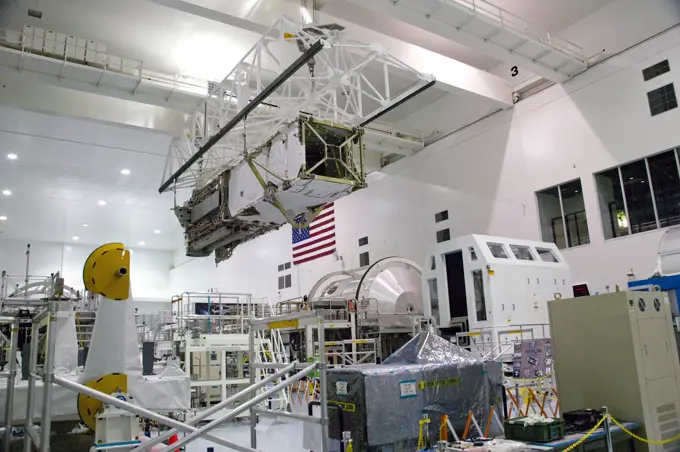
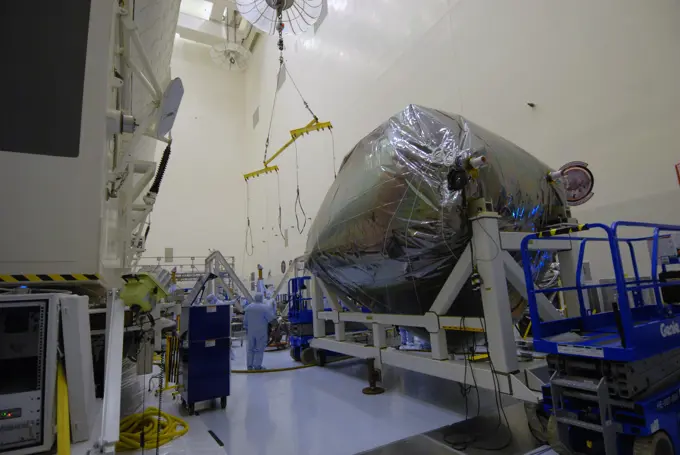
The overhead crane carrying a solar array turns on its axis to move the array to the Integrated Equipment Assembly (IEA) for installation. A component of the International Space Station, the solar array is the second one being installed on the IEA. The arrays are scheduled to be launched on mission STS-97 in late November along with the P6 truss. The Stations electrical power system (EPS) will use eight photovoltaic solar arrays to convert sunlight to electricity. Each of the eight solar arrays will be 112 feet long by 39 feet wide. The solar arrays are mounted on a “blanket” that can be folded like an accordion for delivery. Once in orbit, astronauts will deploy the blankets to their full size. Gimbals will be used to rotate the arrays so that they will face the Sun to provide maximum power to the Space Station

SuperStock offers millions of photos, videos, and stock assets to creatives around the world. This image of The overhead crane carrying a solar array turns on its axis to move the array to the Integrated Equipment Assembly (IEA) for installation. A component of the International Space Station, the solar array is the second one being installed on the IEA. The arrays are scheduled to be launched on mission STS-97 in late November along with the P6 truss. The Stations electrical power system (EPS) will use eight photovoltaic solar arrays to convert sunlight to electricity. Each of the eight solar arrays will be 112 feet long by 39 feet wide. The solar arrays are mounted on a “blanket” that can be folded like an accordion for delivery. Once in orbit, astronauts will deploy the blankets to their full size. Gimbals will be used to rotate the arrays so that they will face the Sun to provide maximum power to the Space Station by Piemags/PL Photography Limited is available for licensing today.
Visually Similar More from NASA Spacecraft Processing story








Looking for a license?
Click here, and we'll help you find it! Questions? Just ask!
Click here, and we'll help you find it! Questions? Just ask!
DETAILS
Image Number: 6145-44508767Royalty FreeCredit Line:Piemags/PL Photography Limited/SuperStockCollection:PL Photography Limited Story:NASA Spacecraft ProcessingContributor:Piemags Model Release:NoProperty Release:NoResolution:1751×2670