Outer Robe (Uchikake) with Scenes of Filial Piety late 18th-early 19th century Japan In the second half of the Edo period, warrior-class women often wore robes with East Asian auspicious, literary, or didactic themes integrated into landscape designs. Embedded in the decoration of this robea winter landscapeare visual references to the fundamental Confucian tenet of filial piety, extolled in Japan as firmly as it had been in ancient Chinese society. One of the most famous collections of such stories advocating respect for one’s ancestors and parents is The Twenty-four Paragons of Filial Piety, based on a Yuan dynasty (1271-1368) text.Among the twenty-four paragons represented here is Wang Xiang (Japanese: ?sh?), a third-century official who, to fulfill his ailing stepmother’s craving for fresh fish in midwinter, caught carp by lying on the ice of a lake until it melted. Wang is represented here by his clothing: an official’s cap and fan lie on the riverbank beneath a pine branch from
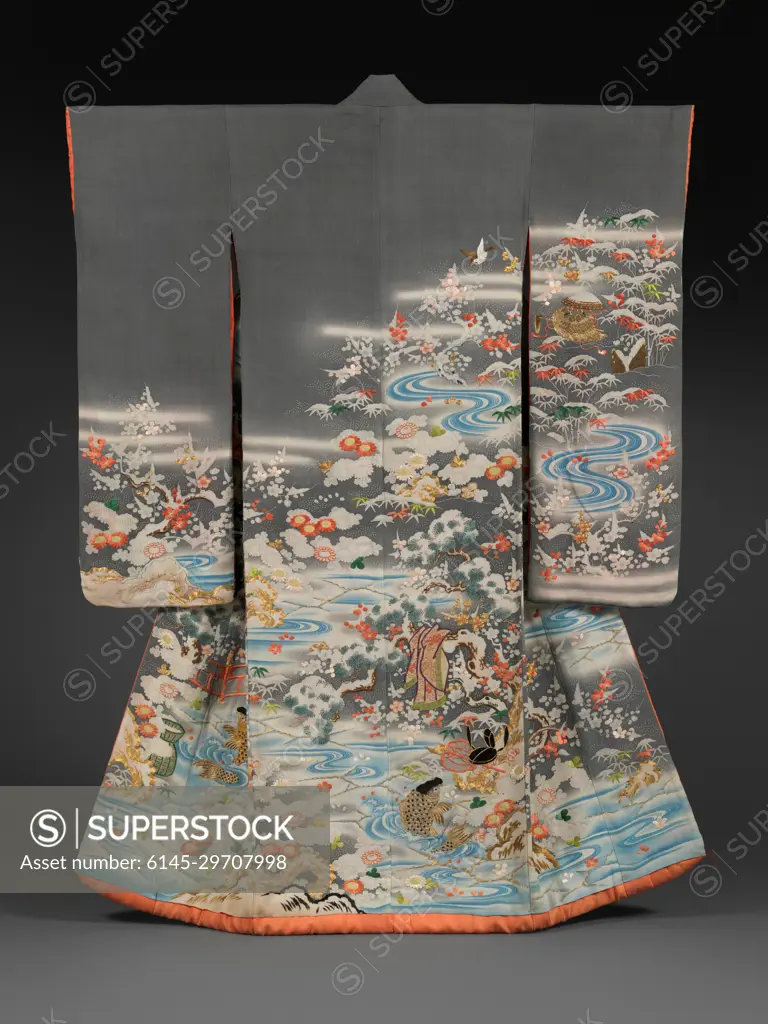
SuperStock offers millions of photos, videos, and stock assets to creatives around the world. This image of Outer Robe (Uchikake) with Scenes of Filial Piety late 18th-early 19th century Japan In the second half of the Edo period, warrior-class women often wore robes with East Asian auspicious, literary, or didactic themes integrated into landscape designs. Embedded in the decoration of this robea winter landscapeare visual references to the fundamental Confucian tenet of filial piety, extolled in Japan as firmly as it had been in ancient Chinese society. One of the most famous collections of such stories advocating respect for one’s ancestors and parents is The Twenty-four Paragons of Filial Piety, based on a Yuan dynasty (1271-1368) text.Among the twenty-four paragons represented here is Wang Xiang (Japanese: ?sh?), a third-century official who, to fulfill his ailing stepmother’s craving for fresh fish in midwinter, caught carp by lying on the ice of a lake until it melted. Wang is represented here by his clothing: an official’s cap and fan lie on the riverbank beneath a pine branch from by Piemags/PL Photography Limited is available for licensing today.
Looking for a license?
Click here, and we'll help you find it! Questions? Just ask!
Click here, and we'll help you find it! Questions? Just ask!
DETAILS
Image Number: 6145-29707998Royalty FreeCredit Line:Piemags/PL Photography Limited/SuperStockCollection:PL Photography Limited Contributor:Piemags Model Release:NoProperty Release:NoResolution:3000×4000