Outer Robe (Uchikake) with Maple Tree and River. Culture: Japan. Dimensions: 65 1/4 x 49 3/4 in. (165.7 x 126.4 cm). Date: first half of the 20th century.The colorful leaves of a maple tree with a river beneath its branches are an allusion to the Tatsuta River in Nara prefecture, famous in classical literature as a place for viewing autumn foliage, and familiar to pilgrims traveling to the Tatsuta Shrine. Chrysanthemums, besides being the representative seasonal flower, might also refer to the legend of the Chrysanthemum Boy (Kikujido), who achieved immortality by drinking dewdrops from the flowers. This robe was prepared for a young upper-class woman. The satin damask fabric features a complex woven design of bridges, pines, and mist, while the white-spotted pattern of the water in the lower part of the textile was created by means of a technique called kanoko shibori, literally "fawn-spot tie dyeing." The maple leaves and chrysanthemums were embroidered with silk and metallic threa
This asset has restrictions and cannot be purchased online. Get in touch for more details.
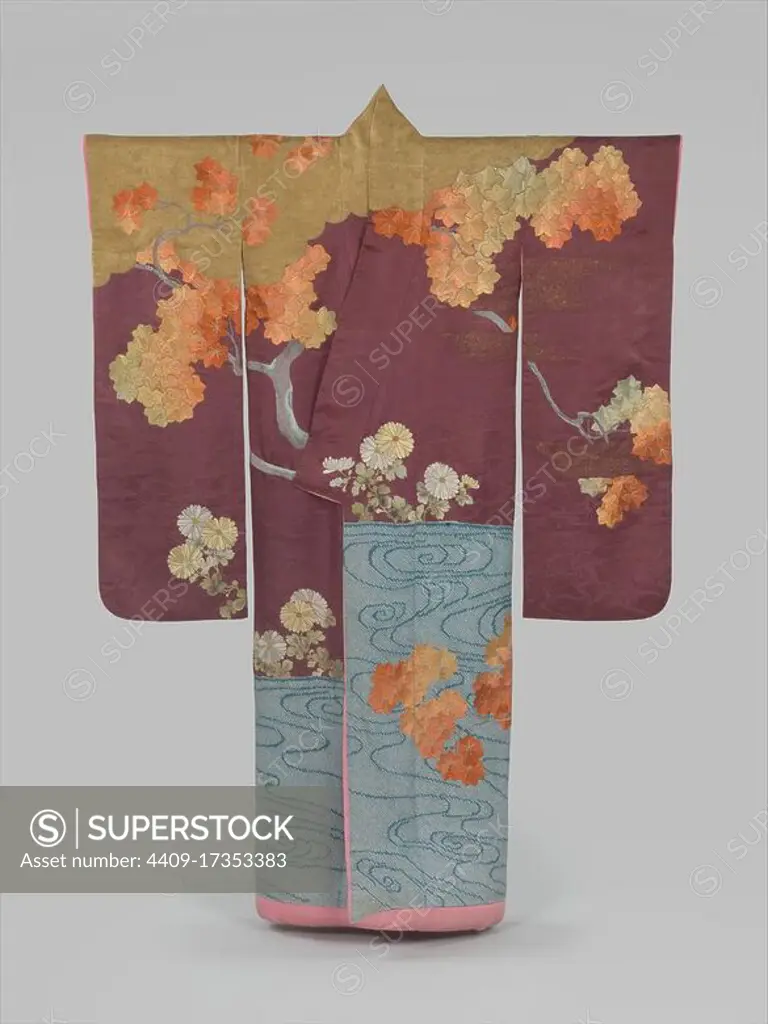
SuperStock offers millions of photos, videos, and stock assets to creatives around the world. This image of Outer Robe (Uchikake) with Maple Tree and River. Culture: Japan. Dimensions: 65 1/4 x 49 3/4 in. (165.7 x 126.4 cm). Date: first half of the 20th century.The colorful leaves of a maple tree with a river beneath its branches are an allusion to the Tatsuta River in Nara prefecture, famous in classical literature as a place for viewing autumn foliage, and familiar to pilgrims traveling to the Tatsuta Shrine. Chrysanthemums, besides being the representative seasonal flower, might also refer to the legend of the Chrysanthemum Boy (Kikujido), who achieved immortality by drinking dewdrops from the flowers. This robe was prepared for a young upper-class woman. The satin damask fabric features a complex woven design of bridges, pines, and mist, while the white-spotted pattern of the water in the lower part of the textile was created by means of a technique called kanoko shibori, literally "fawn-spot tie dyeing." The maple leaves and chrysanthemums were embroidered with silk and metallic threa by Album/Metropolitan Museum of Art, NY/Album Archivo is available for licensing today.
Looking for a license?
Click here, and we'll help you find it! Questions? Just ask!
Click here, and we'll help you find it! Questions? Just ask!
DETAILS
Image Number: 4409-17353383Rights ManagedCredit Line:Album/Metropolitan Museum of Art, NY/Album Archivo/SuperStockCollection:Album Archivo Contributor:Album / Metropolitan Museum of Art, NY Model Release:NoProperty Release:NoResolution:3202×4268