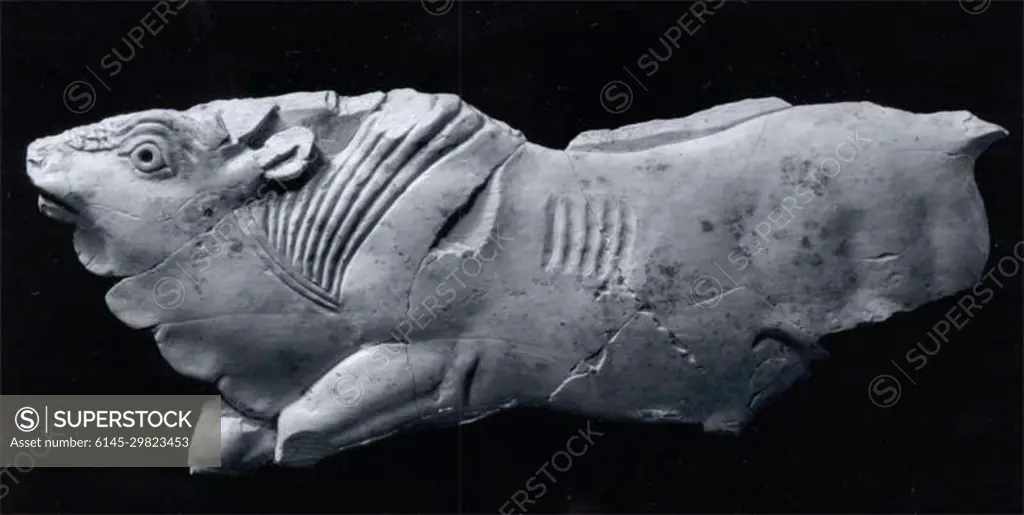
Openwork furniture plaque with galloping bull ca. 9th-8th century B.C. Assyrian This carved ivory plaque was found in a storage room in Fort Shalmaneser, a royal building at Nimrud that was used to store booty and tribute collected by the Assyrians while on military campaign. It depicts a bull galloping to the left; the lower legs, tail, and horns have broken off. The bull is carved in the openwork technique, in which the background is cut away and remaining elements are carved in the round or in high relief, as here. The large eye was drilled to emphasize the pupil, giving it a vivid gaze. The ribs are defined by vertical parallel lines, and similar lines frame the eye and the muscular ridges on the back of the neck. This plaque was probably part of a row of animals positioned in a frieze and used to decorate a piece of furniture. Carved ivory pieces such as this were widely used in the production of elite furniture during the early first millennium B.C. They were often inlaid into a
SuperStock offers millions of photos, videos, and stock assets to creatives around the world. This image of Openwork furniture plaque with galloping bull ca. 9th-8th century B.C. Assyrian This carved ivory plaque was found in a storage room in Fort Shalmaneser, a royal building at Nimrud that was used to store booty and tribute collected by the Assyrians while on military campaign. It depicts a bull galloping to the left; the lower legs, tail, and horns have broken off. The bull is carved in the openwork technique, in which the background is cut away and remaining elements are carved in the round or in high relief, as here. The large eye was drilled to emphasize the pupil, giving it a vivid gaze. The ribs are defined by vertical parallel lines, and similar lines frame the eye and the muscular ridges on the back of the neck. This plaque was probably part of a row of animals positioned in a frieze and used to decorate a piece of furniture. Carved ivory pieces such as this were widely used in the production of elite furniture during the early first millennium B.C. They were often inlaid into a by Piemags/PL Photography Limited is available for licensing today.
Looking for a license?
Click here, and we'll help you find it! Questions? Just ask!
Click here, and we'll help you find it! Questions? Just ask!
DETAILS
Image Number: 6145-29823453Royalty FreeCredit Line:Piemags/PL Photography Limited/SuperStockCollection:PL Photography Limited Contributor:Piemags Model Release:NoProperty Release:NoResolution:800×403