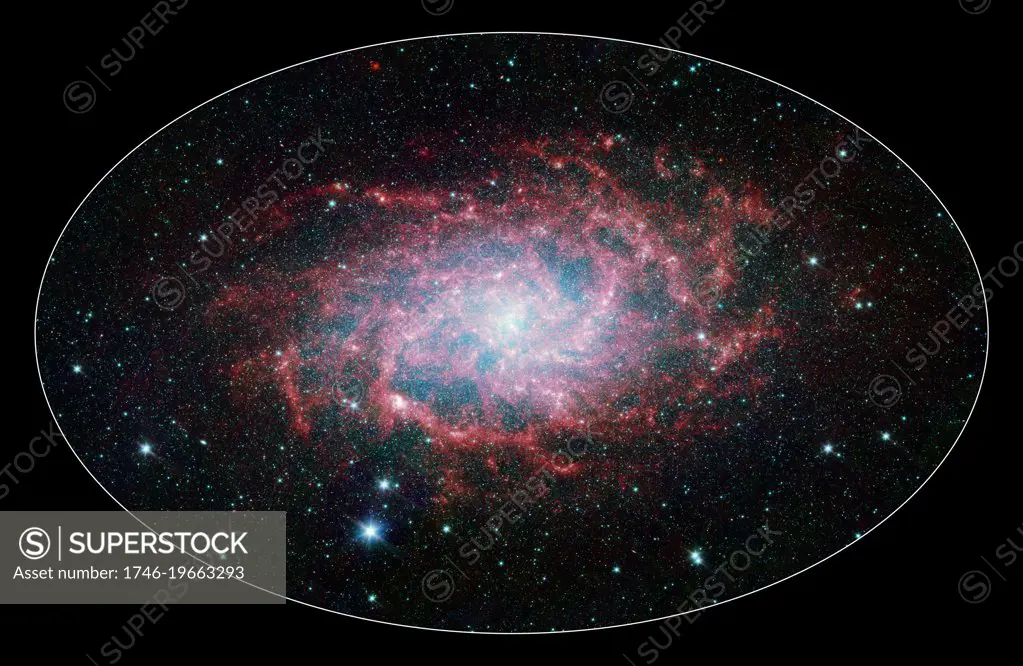
One of our closest galactic neighbours shows its awesome beauty in this new image from NASAs Spitzer Space Telescope. M33, also known as the Triangulum Galaxy, is a member of whats known as our Local Group of galaxies. Along with our own Milky Way, this group travels together in the universe, as they are gravitationally bound. In fact, M33 is one of the few galaxies that is moving toward the Milky Way despite the fact that space itself is expanding, causing most galaxies in the universe to grow farther and farther apart. When viewed with Spitzers infrared eyes, this elegant spiral galaxy sparkles with colour and detail. Stars appear as glistening blue gems (many of which are actually foreground stars in our own galaxy), while dust in the spiral disk of the galaxy glows pink and red. But not only is this new image beautiful, it also shows M33 to be surprising largebigger than its visible-light appearance would suggest. With its ability to detect cold, dark dust, Spitzer can see emis
SuperStock offers millions of photos, videos, and stock assets to creatives around the world. This image of One of our closest galactic neighbours shows its awesome beauty in this new image from NASAs Spitzer Space Telescope. M33, also known as the Triangulum Galaxy, is a member of whats known as our Local Group of galaxies. Along with our own Milky Way, this group travels together in the universe, as they are gravitationally bound. In fact, M33 is one of the few galaxies that is moving toward the Milky Way despite the fact that space itself is expanding, causing most galaxies in the universe to grow farther and farther apart. When viewed with Spitzers infrared eyes, this elegant spiral galaxy sparkles with colour and detail. Stars appear as glistening blue gems (many of which are actually foreground stars in our own galaxy), while dust in the spiral disk of the galaxy glows pink and red. But not only is this new image beautiful, it also shows M33 to be surprising largebigger than its visible-light appearance would suggest. With its ability to detect cold, dark dust, Spitzer can see emis by World History Archive/Image Asset Management is available for licensing today.
Looking for a license?
Click here, and we'll help you find it! Questions? Just ask!
Click here, and we'll help you find it! Questions? Just ask!
DETAILS
Image Number: 1746-19663293Rights ManagedCredit Line:World History Archive/Image Asset Management/SuperStockCollection:Image Asset Management Contributor:World History Archive Model Release:NoProperty Release:NoResolution:5500×3581