Obelisk clock with a Franklin movement ca. 1785-90 Case maker: David Roentgen The unusual obelisk shape of this case accommodates the swing of the pendulum and reflects the new taste for ancient Egyptian art, or Egyptomania,” in Europe at the time. The finial at the top of the clock is, fittingly, in the form of the double-faced head of Janus, the Roman god of beginnings and endings. The simplified movement—consisting of just three wheels, a four-hour spiral-ring dial, and a single minute hand—was invented by Benjamin Franklin in the 1760s or 1770s. Franklin may have come in contact with cabinetmaker David Roentgen and clockmaker Peter Kinzing while in Paris. Kinzing improved upon Franklin’s original model: the addition of a small pointer, seen through an aperture in the minute hand, allowed for a clearer determination of the correct hour. Though Franklin intended for his simplified movement to be used in economically produced clocks, here it has been employed for one of the most luxu
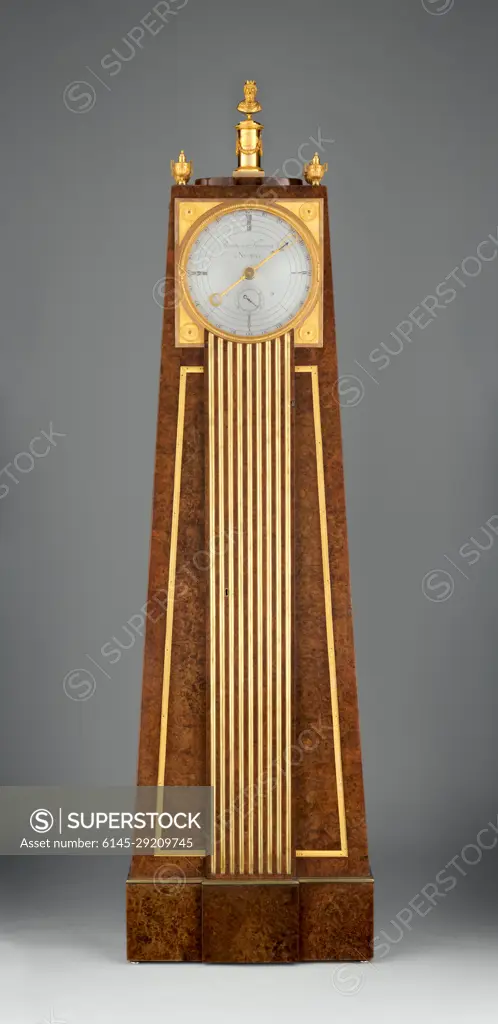
SuperStock offers millions of photos, videos, and stock assets to creatives around the world. This image of Obelisk clock with a Franklin movement ca. 1785-90 Case maker: David Roentgen The unusual obelisk shape of this case accommodates the swing of the pendulum and reflects the new taste for ancient Egyptian art, or Egyptomania,” in Europe at the time. The finial at the top of the clock is, fittingly, in the form of the double-faced head of Janus, the Roman god of beginnings and endings. The simplified movement—consisting of just three wheels, a four-hour spiral-ring dial, and a single minute hand—was invented by Benjamin Franklin in the 1760s or 1770s. Franklin may have come in contact with cabinetmaker David Roentgen and clockmaker Peter Kinzing while in Paris. Kinzing improved upon Franklin’s original model: the addition of a small pointer, seen through an aperture in the minute hand, allowed for a clearer determination of the correct hour. Though Franklin intended for his simplified movement to be used in economically produced clocks, here it has been employed for one of the most luxu by Piemags/PL Photography Limited is available for licensing today.
Looking for a license?
Click here, and we'll help you find it! Questions? Just ask!
Click here, and we'll help you find it! Questions? Just ask!
DETAILS
Image Number: 6145-29209745Royalty FreeCredit Line:Piemags/PL Photography Limited/SuperStockCollection:PL Photography Limited Contributor:Piemags Model Release:NoProperty Release:NoResolution:1947×4000