The 'Nigde' Carpet 18th century The so-called "Nigde Carpet," one of the most famous Islamic carpets, was allegedly discovered in a mosque in the central Anatolian city of Nigde but was probably produced in northwest Iran or Transcaucasia. The origins of its design are indisputably Iranian, as is its overall layout of ogival forms. The composition may have been inspired by a silk textile layout, possibly filtered through the production of the ogival-layout rugs woven in the so-called "vase carpet technique" in Kirman in the seventeenth century. Although mutated into angular and geometric forms, the basic design elements of sinuous Chinese cloud-bands, lotus-flower palmettes, and curved leaves, all part of the rich vocabulary of Safavid carpets, are clearly identifiable in this carpet.. The 'Nigde' Carpet. 18th century. Cotton (warp and weft), wool (pile); symmetrically knotted pile. Made in Northwestern Iran, probably. Textiles-Rugs
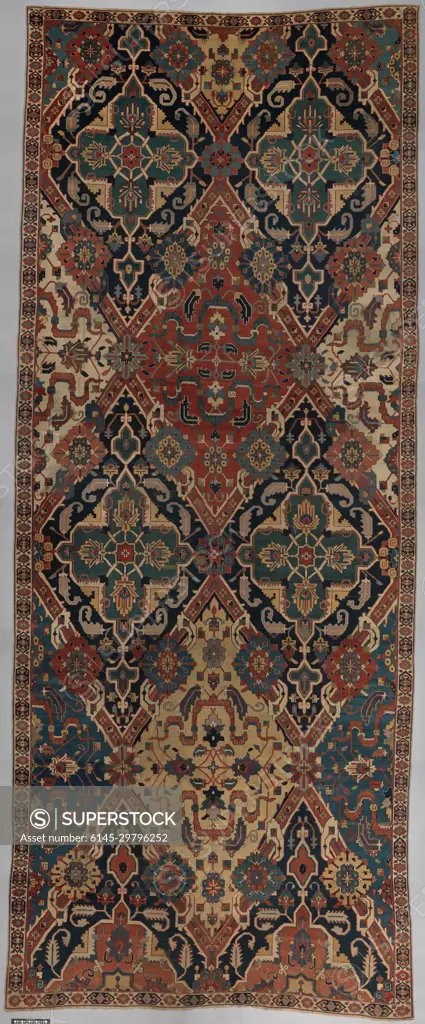
SuperStock offers millions of photos, videos, and stock assets to creatives around the world. This image of The 'Nigde' Carpet 18th century The so-called "Nigde Carpet," one of the most famous Islamic carpets, was allegedly discovered in a mosque in the central Anatolian city of Nigde but was probably produced in northwest Iran or Transcaucasia. The origins of its design are indisputably Iranian, as is its overall layout of ogival forms. The composition may have been inspired by a silk textile layout, possibly filtered through the production of the ogival-layout rugs woven in the so-called "vase carpet technique" in Kirman in the seventeenth century. Although mutated into angular and geometric forms, the basic design elements of sinuous Chinese cloud-bands, lotus-flower palmettes, and curved leaves, all part of the rich vocabulary of Safavid carpets, are clearly identifiable in this carpet.. The 'Nigde' Carpet. 18th century. Cotton (warp and weft), wool (pile); symmetrically knotted pile. Made in Northwestern Iran, probably. Textiles-Rugs by Piemags/PL Photography Limited is available for licensing today.
Looking for a license?
Click here, and we'll help you find it! Questions? Just ask!
Click here, and we'll help you find it! Questions? Just ask!
DETAILS
Image Number: 6145-29796252Royalty FreeCredit Line:Piemags/PL Photography Limited/SuperStockCollection:PL Photography Limited Contributor:Piemags Model Release:NoProperty Release:NoResolution:1663×4000