A new mission competing for selection under NASA's Discovery Program would explore Neptune's largest moon, Triton, which is potentially an ocean world with liquid water under its icy crust. Trident aims to answer the questions outlined in the graphic illustration above. The questions fall under Trident's three main goals. The first goal is to explore the factors that lead to a solar system body having the necessary ingredients including water to be habitable. A second goal is to explore vast, unseen lands. Most of what we know of the moon came from Voyager 2 data. But we've only seen 40% of the moon's surface; Trident would map most of the remainder. Trident's third major goal to understand how Triton's surface keeps renewing itself. The surface is remarkably young, geologically speaking (possibly only 10 million years old in a 4.6-billion-year-old solar system) and has almost no visible craters. The Trident team is one of four developing concept studies for new missions. Up to two
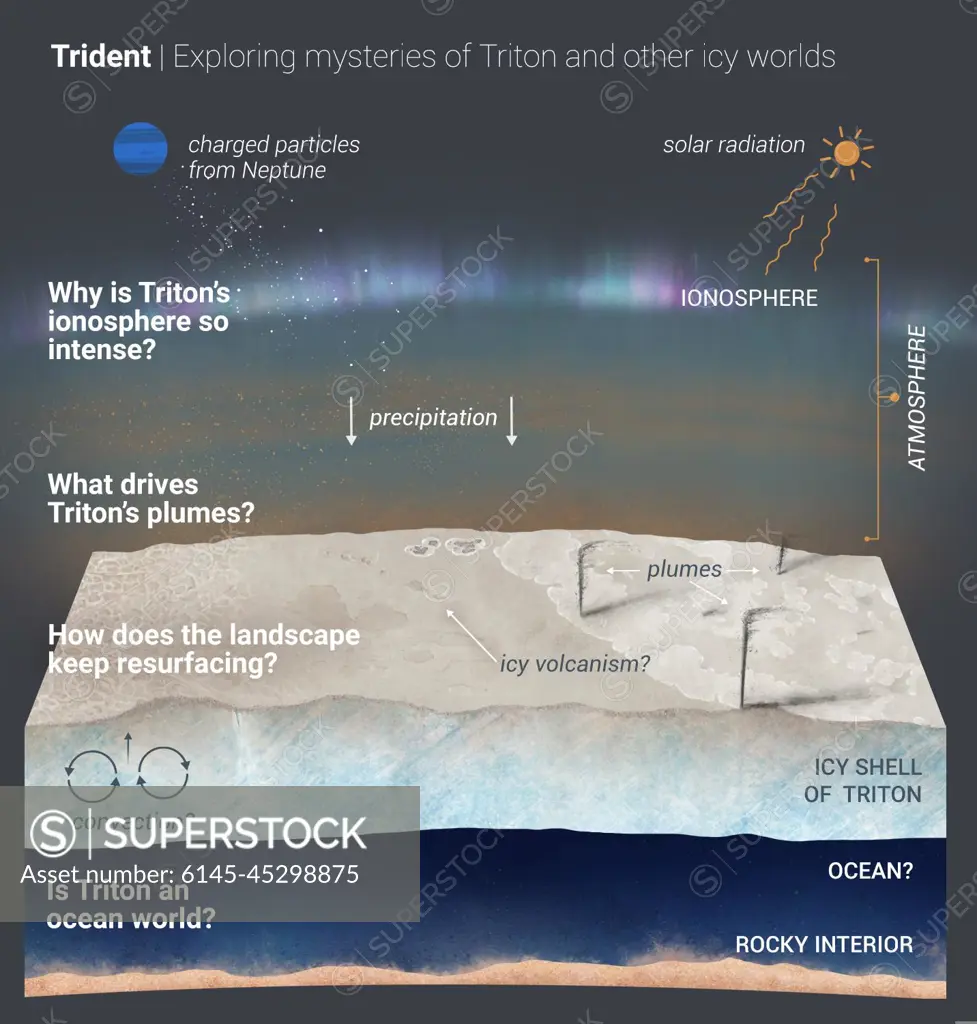
SuperStock offers millions of photos, videos, and stock assets to creatives around the world. This image of A new mission competing for selection under NASA's Discovery Program would explore Neptune's largest moon, Triton, which is potentially an ocean world with liquid water under its icy crust. Trident aims to answer the questions outlined in the graphic illustration above. The questions fall under Trident's three main goals. The first goal is to explore the factors that lead to a solar system body having the necessary ingredients including water to be habitable. A second goal is to explore vast, unseen lands. Most of what we know of the moon came from Voyager 2 data. But we've only seen 40% of the moon's surface; Trident would map most of the remainder. Trident's third major goal to understand how Triton's surface keeps renewing itself. The surface is remarkably young, geologically speaking (possibly only 10 million years old in a 4.6-billion-year-old solar system) and has almost no visible craters. The Trident team is one of four developing concept studies for new missions. Up to two by Piemags/PL Photography Limited is available for licensing today.
Visually Similar More from Solar System Illustrations story


Looking for a license?
Click here, and we'll help you find it! Questions? Just ask!
Click here, and we'll help you find it! Questions? Just ask!
DETAILS
Image Number: 6145-45298875Royalty FreeCredit Line:Piemags/PL Photography Limited/SuperStockCollection:PL Photography Limited Story:Solar System IllustrationsContributor:Piemags Model Release:NoProperty Release:NoResolution:1432×1500