Mute Viola d'Amore mid-18th century Daniel Achatius Stadlmann Austrian The viola d'amore, or viola "of love," is a bowed stringed instrument which gained great popularity in the eighteenth century. Much of its history, including the derivation of its name, is unknown. It has many characteristics of the viol family such as a flat back, ribs that are flush with the top and back, and a rosette in addition to soundholes. Yet, like a violin, it is unfretted and held under the chin while played. Violas d'amore typically have seven playing strings, though instruments with other numbers of strings are not unusual. Perhaps the most distinguishable characteristic of the eighteenth-century viola d'amore is the presence of sympathetic strings, which are not played but located behind the bowed strings and vibrate "in sympathy." The sympathetic strings contribute to produce a tone that is clear and often described as "silvery," as well as creating a more resonant sound with a longer decay. Sympathet
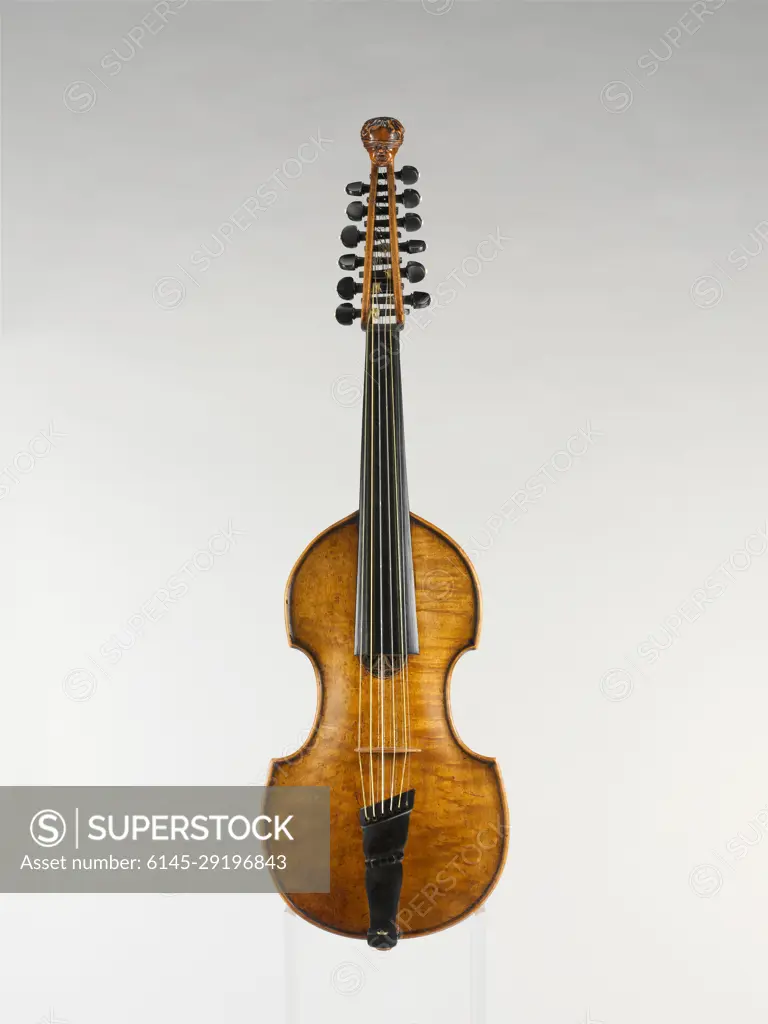
SuperStock offers millions of photos, videos, and stock assets to creatives around the world. This image of Mute Viola d'Amore mid-18th century Daniel Achatius Stadlmann Austrian The viola d'amore, or viola "of love," is a bowed stringed instrument which gained great popularity in the eighteenth century. Much of its history, including the derivation of its name, is unknown. It has many characteristics of the viol family such as a flat back, ribs that are flush with the top and back, and a rosette in addition to soundholes. Yet, like a violin, it is unfretted and held under the chin while played. Violas d'amore typically have seven playing strings, though instruments with other numbers of strings are not unusual. Perhaps the most distinguishable characteristic of the eighteenth-century viola d'amore is the presence of sympathetic strings, which are not played but located behind the bowed strings and vibrate "in sympathy." The sympathetic strings contribute to produce a tone that is clear and often described as "silvery," as well as creating a more resonant sound with a longer decay. Sympathet by Piemags/PL Photography Limited is available for licensing today.
Looking for a license?
Click here, and we'll help you find it! Questions? Just ask!
Click here, and we'll help you find it! Questions? Just ask!
DETAILS
Image Number: 6145-29196843Royalty FreeCredit Line:Piemags/PL Photography Limited/SuperStockCollection:PL Photography Limited Contributor:Piemags Model Release:NoProperty Release:NoResolution:3000×4000