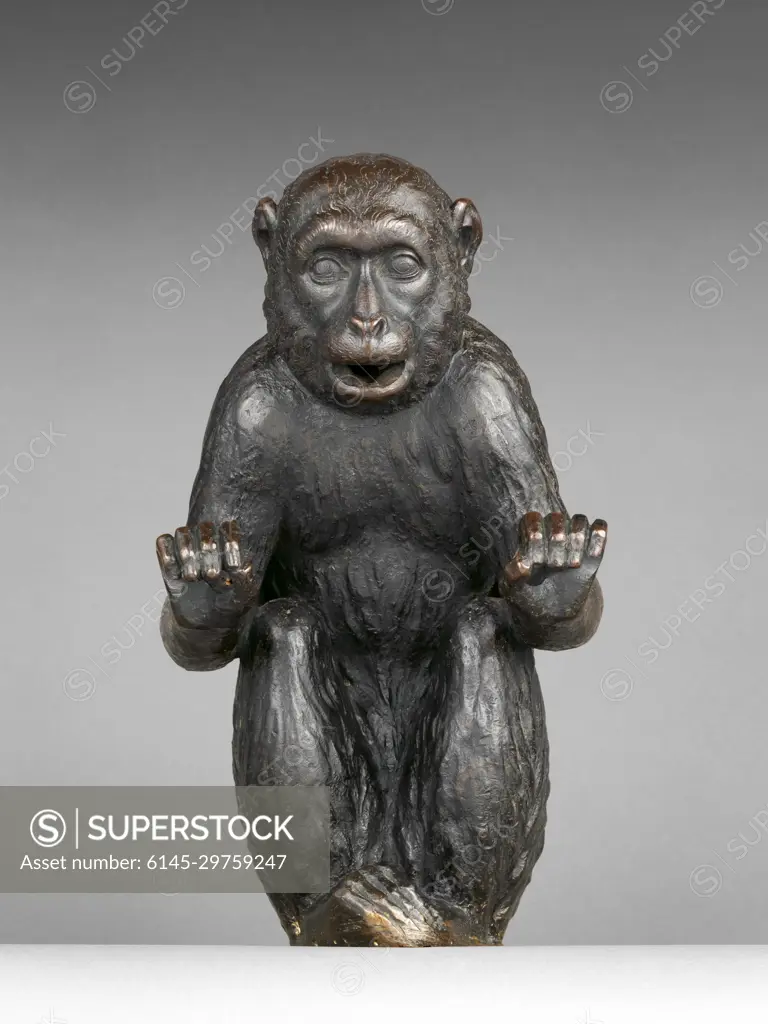
Monkey fountain figure ca. 1600 Possibly Caspar Gras The Monkey crouches balancing itself on crossed paws. It hunches, shoulders forward, collared neck tucked in, and braces its forearms against its knees to better hold a lost object, perhaps a rod or a chain, in its hands. The head is inclined forward; the parted mouth, flared nostrils, and direct gaze communicate alertness. This work was probably part of a now lost group of animal sculptures and may have decorated a fountain.Probably modelled after a living macaque monkey; this life-sized sculpture captures the species physical features, posture, and energy with a high degree of naturalism. During the Renaissance, wild macaques (Macaca sylvanus) imported from Gibraltar and North Africa were popular throughout Europe; artists could have studied them in royal menageries. Because of its skill at mimicry the monkey was a symbol of painting and sculpture - the arts which emulate or "ape" nature.. Monkey fountain figure. Possibly Caspar G
SuperStock offers millions of photos, videos, and stock assets to creatives around the world. This image of Monkey fountain figure ca. 1600 Possibly Caspar Gras The Monkey crouches balancing itself on crossed paws. It hunches, shoulders forward, collared neck tucked in, and braces its forearms against its knees to better hold a lost object, perhaps a rod or a chain, in its hands. The head is inclined forward; the parted mouth, flared nostrils, and direct gaze communicate alertness. This work was probably part of a now lost group of animal sculptures and may have decorated a fountain.Probably modelled after a living macaque monkey; this life-sized sculpture captures the species physical features, posture, and energy with a high degree of naturalism. During the Renaissance, wild macaques (Macaca sylvanus) imported from Gibraltar and North Africa were popular throughout Europe; artists could have studied them in royal menageries. Because of its skill at mimicry the monkey was a symbol of painting and sculpture - the arts which emulate or "ape" nature.. Monkey fountain figure. Possibly Caspar G by Piemags/PL Photography Limited is available for licensing today.
Looking for a license?
Click here, and we'll help you find it! Questions? Just ask!
Click here, and we'll help you find it! Questions? Just ask!
DETAILS
Image Number: 6145-29759247Royalty FreeCredit Line:Piemags/PL Photography Limited/SuperStockCollection:PL Photography Limited Contributor:Piemags Model Release:NoProperty Release:NoResolution:3000×4000