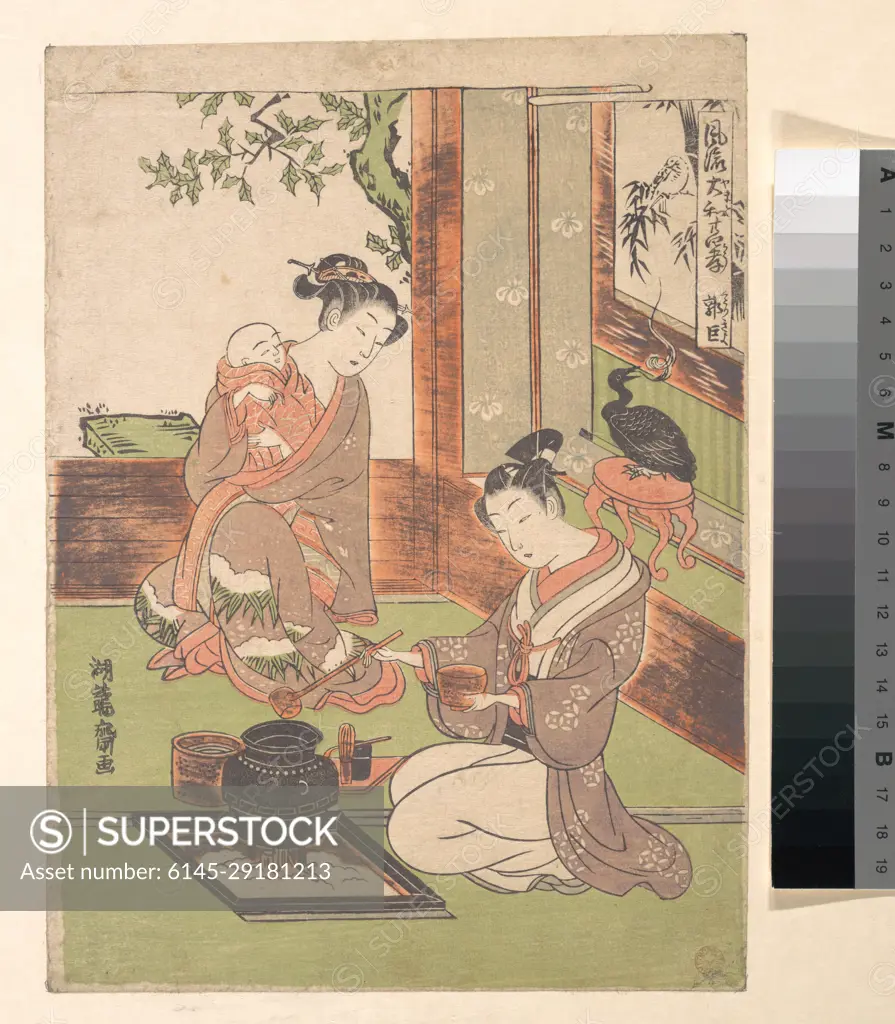
Modern Versions of the twenty-four Paragons of Filial Piety: Guo Zhu ca. 1770 Isoda Koryūsai Japanese As his young wife watches raptly, a young man is taking boiling water with a bamboo ladle from an iron tea cauldron in a square hearth set into the tatami mat floor. Behind him a Chinese-style painting of a bird in bamboo is hung before a bird-shaped incense burner in the tokonoma alcove. This scene of domestic tranquility focused on the cauldron and other utensils of the formal tea ceremony (chanoyu) is in fact a witty parody of one of the moralizing tales propagated in Confucianism, the official ideology of the Tokugawa shogunate. Guo Zhu, said to have lived in the second century A.D. in China, was so devoted to his aged mother that, finding himself unable to support his entire family, he persuaded his wife that they should bury their infant son to be able to feed her. As he was digging the grave, he uncovered a cauldron of gold, a just reward which saved him from a painful, extreme
SuperStock offers millions of photos, videos, and stock assets to creatives around the world. This image of Modern Versions of the twenty-four Paragons of Filial Piety: Guo Zhu ca. 1770 Isoda Koryūsai Japanese As his young wife watches raptly, a young man is taking boiling water with a bamboo ladle from an iron tea cauldron in a square hearth set into the tatami mat floor. Behind him a Chinese-style painting of a bird in bamboo is hung before a bird-shaped incense burner in the tokonoma alcove. This scene of domestic tranquility focused on the cauldron and other utensils of the formal tea ceremony (chanoyu) is in fact a witty parody of one of the moralizing tales propagated in Confucianism, the official ideology of the Tokugawa shogunate. Guo Zhu, said to have lived in the second century A.D. in China, was so devoted to his aged mother that, finding himself unable to support his entire family, he persuaded his wife that they should bury their infant son to be able to feed her. As he was digging the grave, he uncovered a cauldron of gold, a just reward which saved him from a painful, extreme by Piemags/PL Photography Limited is available for licensing today.
Looking for a license?
Click here, and we'll help you find it! Questions? Just ask!
Click here, and we'll help you find it! Questions? Just ask!
DETAILS
Image Number: 6145-29181213Royalty FreeCredit Line:Piemags/PL Photography Limited/SuperStockCollection:PL Photography Limited Contributor:Piemags Model Release:NoProperty Release:NoResolution:3497×4000