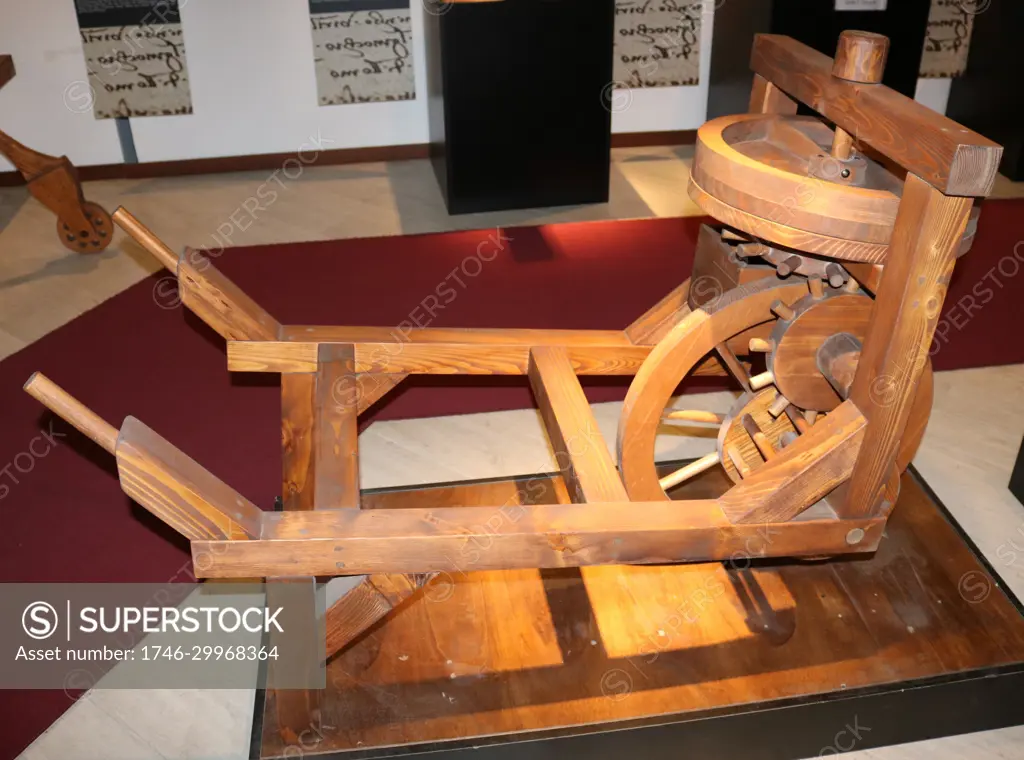
model of an Odometer that Leonardo da Vinci drew on the first folio of his Codex Atlanticus, folio 1 r. 1504. This is a machine calculated distance travelled. This machine, however, was already known in antiquity, given that Leonardo did nothing more than re-elaborate the Odometer devised by Heron Alexandrinus, a Greek inventor who lived in the First century AD. Unlike the former one, the Odometer that Leonardo designed was shaped a little like a push cart and had a toothed wheel mechanism. Each time the wheel on die ground turned, the vertical toothed wheel turned once, in turn actuating a horizontal wheel. The latter contained metal balls or stones, which fell through a hole into a bucket: counting them at the end of the journey allowed the distance travelled to be calculated.
SuperStock offers millions of photos, videos, and stock assets to creatives around the world. This image of model of an Odometer that Leonardo da Vinci drew on the first folio of his Codex Atlanticus, folio 1 r. 1504. This is a machine calculated distance travelled. This machine, however, was already known in antiquity, given that Leonardo did nothing more than re-elaborate the Odometer devised by Heron Alexandrinus, a Greek inventor who lived in the First century AD. Unlike the former one, the Odometer that Leonardo designed was shaped a little like a push cart and had a toothed wheel mechanism. Each time the wheel on die ground turned, the vertical toothed wheel turned once, in turn actuating a horizontal wheel. The latter contained metal balls or stones, which fell through a hole into a bucket: counting them at the end of the journey allowed the distance travelled to be calculated. by World History Archive/Image Asset Management is available for licensing today.
Looking for a license?
Click here, and we'll help you find it! Questions? Just ask!
Click here, and we'll help you find it! Questions? Just ask!
DETAILS
Image Number: 1746-29968364Rights ManagedCredit Line:World History Archive/Image Asset Management/SuperStockCollection:Image Asset Management Contributor:World History Archive Model Release:NoProperty Release:NoResolution:5315×3946