Mirror with a Pair of Addorsed Sphinxes with Scorpion Tails. Dimensions: H. 7/16 in. (1.1 cm)Diam. 4 1/8 in. (10.5 cm)Wt. 8.8 oz. (249.5 g). Date: 12th-13th century.Polished-metal mirrors have existed since ancient times, from Egypt to Greece to China. The medieval Islamic period, specifically during the rise of the Seljuqs and other Turkish dynasties, witnessed the production of a large number of circular cast-bronze mirrors with a fully decorated reverse. Despite a relatively short phase of manufacture (twelfth to the thirteenth century), they enjoyed wide popularity within and beyond the Seljuq realm. The simple technique of sand-cast bronze would have enabled mass production for a broad market, as demonstrated by the large number of mirrors with similar motifs (specifically the type featuring a pair of sphinxes with scorpion tails). Beyond their practical function, they served as talismans, given their benedictory inscriptions and apotropaic motifs. Some are believed to have been u
This asset has restrictions and cannot be purchased online. Get in touch for more details.
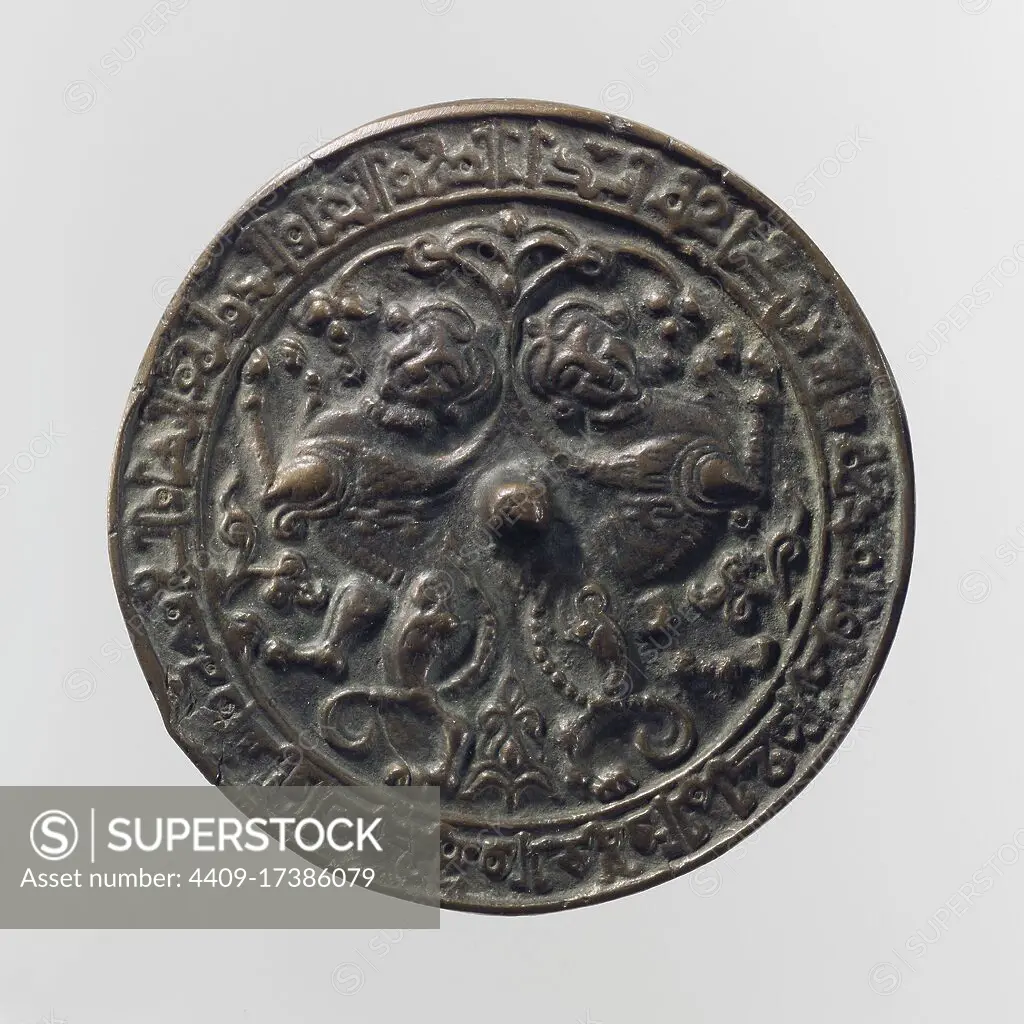
SuperStock offers millions of photos, videos, and stock assets to creatives around the world. This image of Mirror with a Pair of Addorsed Sphinxes with Scorpion Tails. Dimensions: H. 7/16 in. (1.1 cm)Diam. 4 1/8 in. (10.5 cm)Wt. 8.8 oz. (249.5 g). Date: 12th-13th century.Polished-metal mirrors have existed since ancient times, from Egypt to Greece to China. The medieval Islamic period, specifically during the rise of the Seljuqs and other Turkish dynasties, witnessed the production of a large number of circular cast-bronze mirrors with a fully decorated reverse. Despite a relatively short phase of manufacture (twelfth to the thirteenth century), they enjoyed wide popularity within and beyond the Seljuq realm. The simple technique of sand-cast bronze would have enabled mass production for a broad market, as demonstrated by the large number of mirrors with similar motifs (specifically the type featuring a pair of sphinxes with scorpion tails). Beyond their practical function, they served as talismans, given their benedictory inscriptions and apotropaic motifs. Some are believed to have been u by Album/Metropolitan Museum of Art, NY/Album Archivo is available for licensing today.
Looking for a license?
Click here, and we'll help you find it! Questions? Just ask!
Click here, and we'll help you find it! Questions? Just ask!
DETAILS
Image Number: 4409-17386079Rights ManagedCredit Line:Album/Metropolitan Museum of Art, NY/Album Archivo/SuperStockCollection:Album Archivo Contributor:Album / Metropolitan Museum of Art, NY Model Release:NoProperty Release:NoResolution:4200×4200