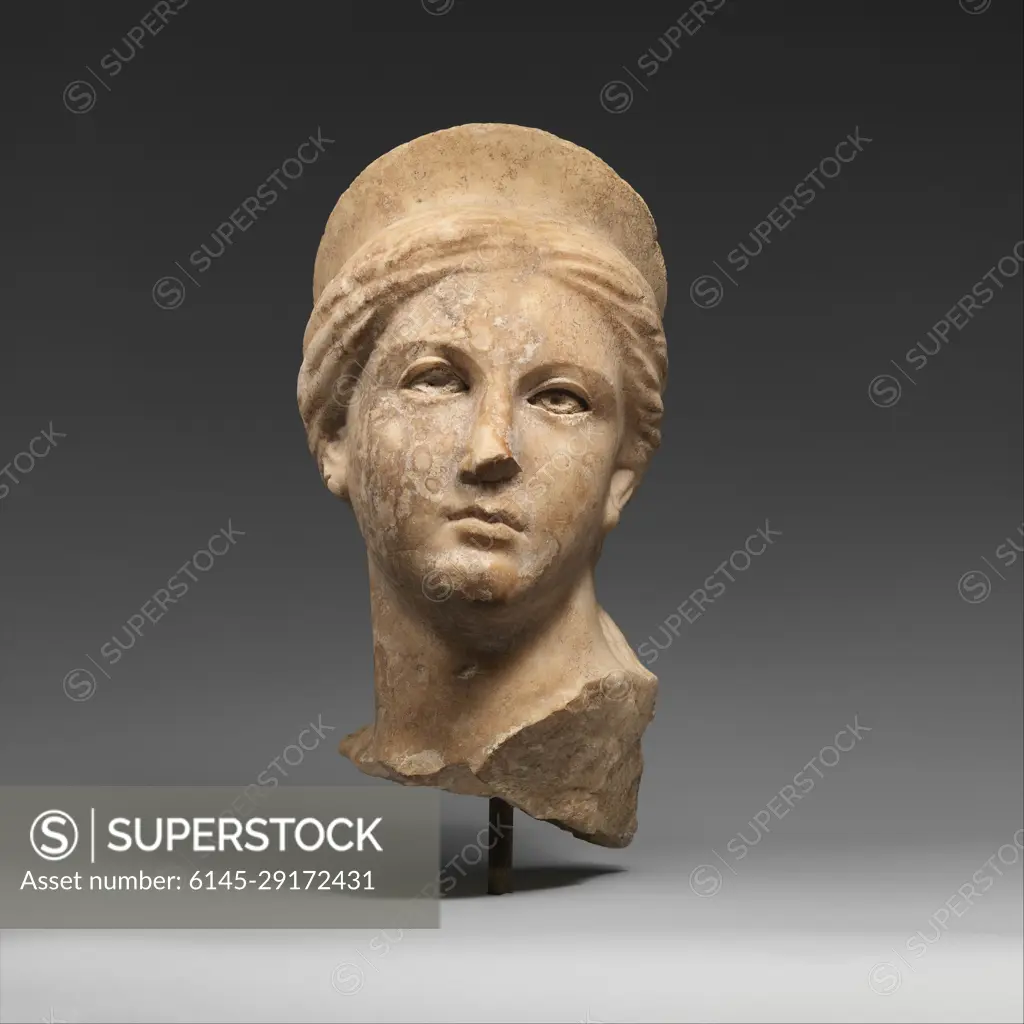
Marble head of a goddess 2nd-1st century B.C. Greek The idealized features and crown identify this striking portrait as the image of a goddess, perhaps Aphrodite or Artemis. The pale translucent yellow hue of the calcite alabaster, now discolored from centuries of burial in the earth, would originally have contrasted with the pure white of her eyes, made of chalk, which once featured inlays for the irises and pupils. Earrings of gold or another contrasting material would have hung from her pierced ears. Other details, such as the decoration of her crown, were surely rendered with paint. The goddess's hair, parted at the center of the forehead, is pulled back in two rolls along the sides of the head and braided at the nape of her neck, where the ends rest against her skin just above the upper edge of her garment. The dramatic turn of her head, the unfinished top above the crown and the fact that the artist paid less attention to the back indicate that the statue was a dynamic, full- fig
SuperStock offers millions of photos, videos, and stock assets to creatives around the world. This image of Marble head of a goddess 2nd-1st century B.C. Greek The idealized features and crown identify this striking portrait as the image of a goddess, perhaps Aphrodite or Artemis. The pale translucent yellow hue of the calcite alabaster, now discolored from centuries of burial in the earth, would originally have contrasted with the pure white of her eyes, made of chalk, which once featured inlays for the irises and pupils. Earrings of gold or another contrasting material would have hung from her pierced ears. Other details, such as the decoration of her crown, were surely rendered with paint. The goddess's hair, parted at the center of the forehead, is pulled back in two rolls along the sides of the head and braided at the nape of her neck, where the ends rest against her skin just above the upper edge of her garment. The dramatic turn of her head, the unfinished top above the crown and the fact that the artist paid less attention to the back indicate that the statue was a dynamic, full- fig by Piemags/PL Photography Limited is available for licensing today.
Looking for a license?
Click here, and we'll help you find it! Questions? Just ask!
Click here, and we'll help you find it! Questions? Just ask!
DETAILS
Image Number: 6145-29172431Royalty FreeCredit Line:Piemags/PL Photography Limited/SuperStockCollection:PL Photography Limited Contributor:Piemags Model Release:NoProperty Release:NoResolution:3860×3860