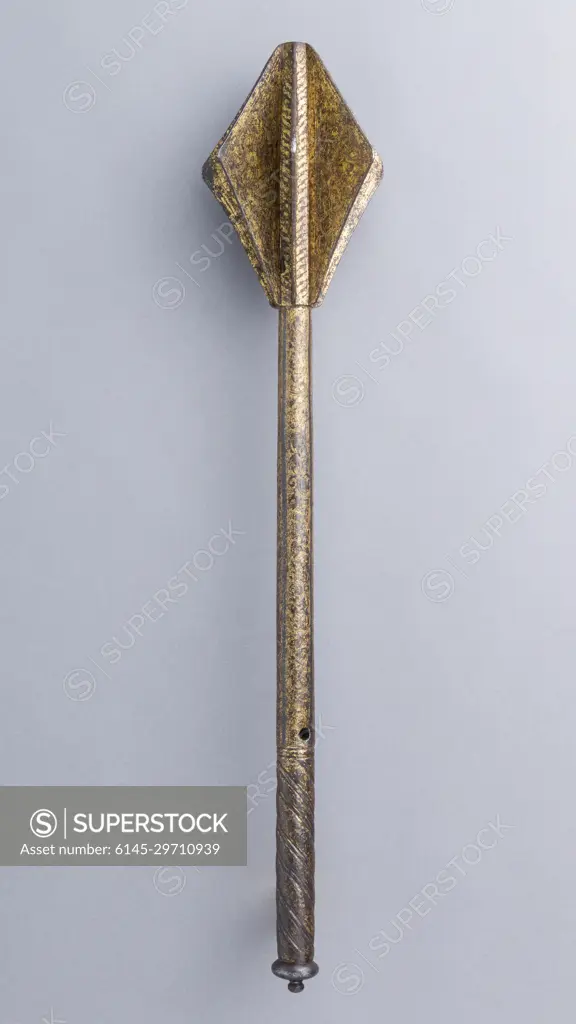
Mace ca. 1575 to 1600 Italian The large steel head of this mace is composed of seven triangular flanges etched overall with trophies and scattered elements of armor on a dotted background; the spaces between the flanges are filled with twisted strapwork. The steel cylindrical shaft is hollow, its etched decoration en suite is arranged in four lengthwise bands, the spiral grip also etched en suite. The shaft is pierced just above the grip for a wrist strap. The decoration on this fully gilded mace is in the same style as on an armor in the Metropolitan Museum's collection (acc. no. 14.25.717a-r).Maces became increasingly popular during the fifteenth and sixteenth centuries--a parallel to the use of the war hammer--due to the ineffectiveness of edged weapons against fully developed plate armor. Though the blow of a mace could not penetrate the armor plates, it might be enough to stun or disable an opponent. Maces were used by cavalrymen, and even became a badge of rank, as was certainly
SuperStock offers millions of photos, videos, and stock assets to creatives around the world. This image of Mace ca. 1575 to 1600 Italian The large steel head of this mace is composed of seven triangular flanges etched overall with trophies and scattered elements of armor on a dotted background; the spaces between the flanges are filled with twisted strapwork. The steel cylindrical shaft is hollow, its etched decoration en suite is arranged in four lengthwise bands, the spiral grip also etched en suite. The shaft is pierced just above the grip for a wrist strap. The decoration on this fully gilded mace is in the same style as on an armor in the Metropolitan Museum's collection (acc. no. 14.25.717a-r).Maces became increasingly popular during the fifteenth and sixteenth centuries--a parallel to the use of the war hammer--due to the ineffectiveness of edged weapons against fully developed plate armor. Though the blow of a mace could not penetrate the armor plates, it might be enough to stun or disable an opponent. Maces were used by cavalrymen, and even became a badge of rank, as was certainly by Piemags/PL Photography Limited is available for licensing today.
Looking for a license?
Click here, and we'll help you find it! Questions? Just ask!
Click here, and we'll help you find it! Questions? Just ask!
DETAILS
Image Number: 6145-29710939Royalty FreeCredit Line:Piemags/PL Photography Limited/SuperStockCollection:PL Photography Limited Contributor:Piemags Model Release:NoProperty Release:NoResolution:2250×4000