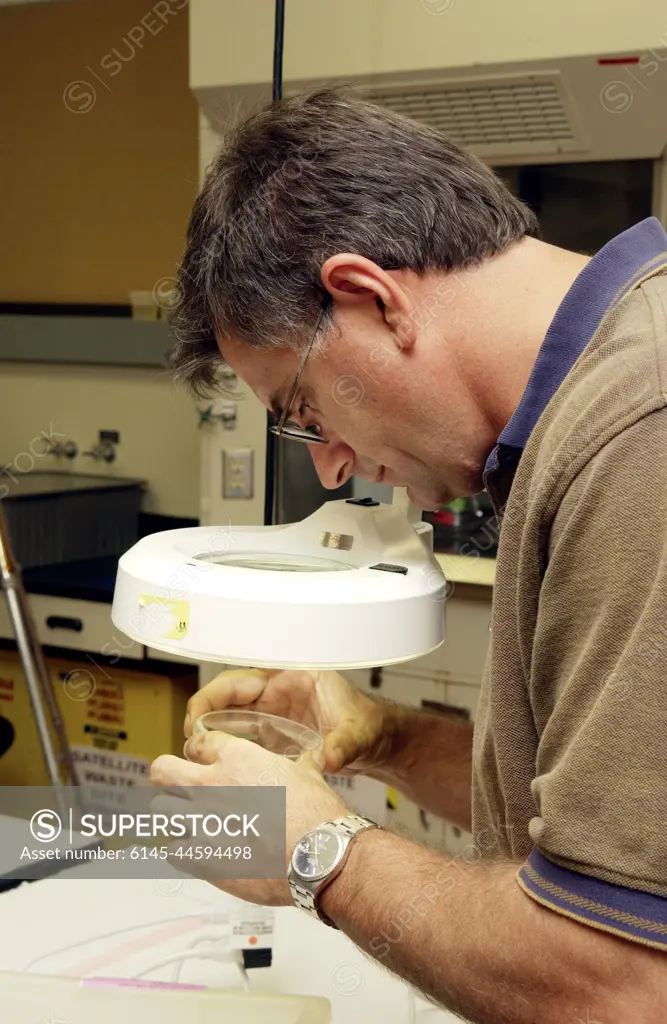
KENNEDY SPACE CENTER, FLA. - Bionetics Project Engineer William McLamb examines a petri dish containing C. elegans nemotodes (round worms). These specimens were found in a Biological Research in Canisters (BRIC) container, a middeck experiment that was among the Columbia debris recovered in East Texas. The worms are descendants of those that were part of an experiment that flew on Columbia's last mission, STS-107. The experiment was designed to verify a new synthetic nutrient solution for an International Space Station (ISS) "model" specimen planned to be used extensively for ISS gene expression studies and was sponsored by the NASA Ames Research Center. Scientists are now looking over the experiment at KSC to determine if it will yield any scientific results. The investigation into the cause of the Columbia accident is ongoing.
SuperStock offers millions of photos, videos, and stock assets to creatives around the world. This image of KENNEDY SPACE CENTER, FLA. - Bionetics Project Engineer William McLamb examines a petri dish containing C. elegans nemotodes (round worms). These specimens were found in a Biological Research in Canisters (BRIC) container, a middeck experiment that was among the Columbia debris recovered in East Texas. The worms are descendants of those that were part of an experiment that flew on Columbia's last mission, STS-107. The experiment was designed to verify a new synthetic nutrient solution for an International Space Station (ISS) "model" specimen planned to be used extensively for ISS gene expression studies and was sponsored by the NASA Ames Research Center. Scientists are now looking over the experiment at KSC to determine if it will yield any scientific results. The investigation into the cause of the Columbia accident is ongoing. by Piemags/PL Photography Limited is available for licensing today.
Looking for a license?
Click here, and we'll help you find it! Questions? Just ask!
Click here, and we'll help you find it! Questions? Just ask!
DETAILS
Image Number: 6145-44594498Royalty FreeCredit Line:Piemags/PL Photography Limited/SuperStockCollection:PL Photography Limited Story:Nuclear Testing and Technology EquipmentContributor:Piemags Model Release:NoProperty Release:NoResolution:1955×3000