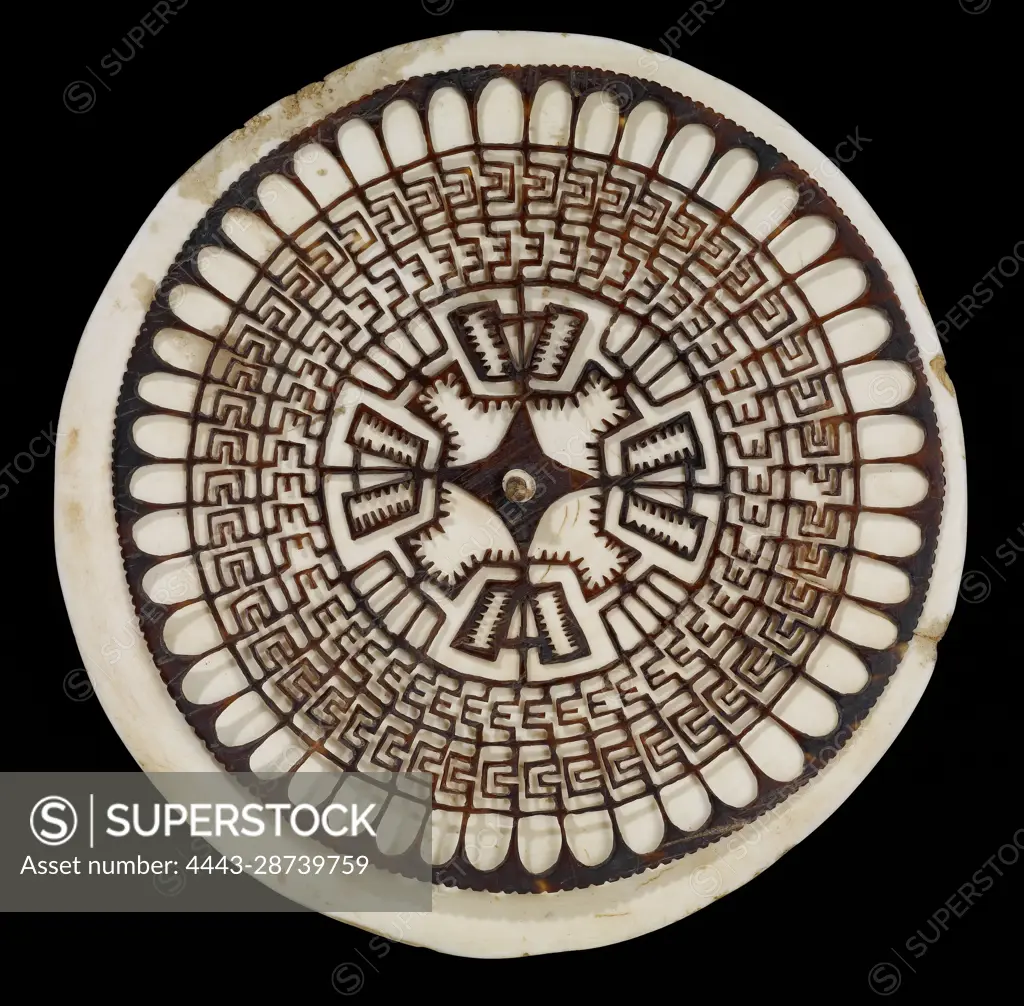
Kapkap, 19th century, 3/8 x 6 in. (0.95 x 15.24 cm) (without cord), Clam shell, tortoise shell, cord, shell beads, Solomon Islands, 19th century, Kapkap were worn as pendants, and forehead or belt ornaments by men in the Solomon Islands. Worn in battle and at festivals, these ornaments symbolized personal wealth and status. The size and quality of a man's kapkap generally indicated his social status-the bigger the size, the more valuable it was. The white disk is ground from the shell of the Tridacna, a large sea clam, which was also used for money. The brown inner disk was carved from boiled tortoiseshell and attached to the other half of the ornament by a beaded string. The addition of beads further increased its value and prestige. Kapkap from the Solomon Islands were traded throughout Melanesia, and are still highly valued today for their beauty and use as exchange goods.
SuperStock offers millions of photos, videos, and stock assets to creatives around the world. This image of Kapkap, 19th century, 3/8 x 6 in. (0.95 x 15.24 cm) (without cord), Clam shell, tortoise shell, cord, shell beads, Solomon Islands, 19th century, Kapkap were worn as pendants, and forehead or belt ornaments by men in the Solomon Islands. Worn in battle and at festivals, these ornaments symbolized personal wealth and status. The size and quality of a man's kapkap generally indicated his social status-the bigger the size, the more valuable it was. The white disk is ground from the shell of the Tridacna, a large sea clam, which was also used for money. The brown inner disk was carved from boiled tortoiseshell and attached to the other half of the ornament by a beaded string. The addition of beads further increased its value and prestige. Kapkap from the Solomon Islands were traded throughout Melanesia, and are still highly valued today for their beauty and use as exchange goods. by Artokoloro is available for licensing today.
Looking for a license?
Click here, and we'll help you find it! Questions? Just ask!
Click here, and we'll help you find it! Questions? Just ask!
DETAILS
Image Number: 4443-28739759Rights ManagedCredit Line:Artokoloro/SuperStockCollection:Artokoloro Model Release:NoProperty Release:NoResolution:5012×4924