Juno, Seated on a Golden Throne, Asks Alecto to Confuse the Trojans (Aeneid, Book VI). Artist: Master of the Aeneid (active ca. 1530-40). Culture: French, Limoges. Dimensions: 9 x 8 in. (22.9 x 20.3 cm). Date: ca. 1530-35.European of the Renaissance period viewed ancient Rome not only as the origin of Italian civilzation but also the geographic center of a lost golden age. This plaque belongs to a series of at least eighty Limoges enamels illustrating events from Virgil's Aeneid. The Latin epic poem tells the story of the legendary hero Aeneas, who escaped the sack and burning of Troy by the Greeks and, after wandering for some time, settled in Italy, where his descendants founded Rome.The scenes are not, however, the product of the enameler's imagination; rather, they are close copies of the woodcut illustrations for the edition of the Latin poet's Opera printed by Johann Grüninger in Strasbourg in 1502. The same woodcuts were used again for the edition published in Lyon in 1517. The
This asset has restrictions and cannot be purchased online. Get in touch for more details.
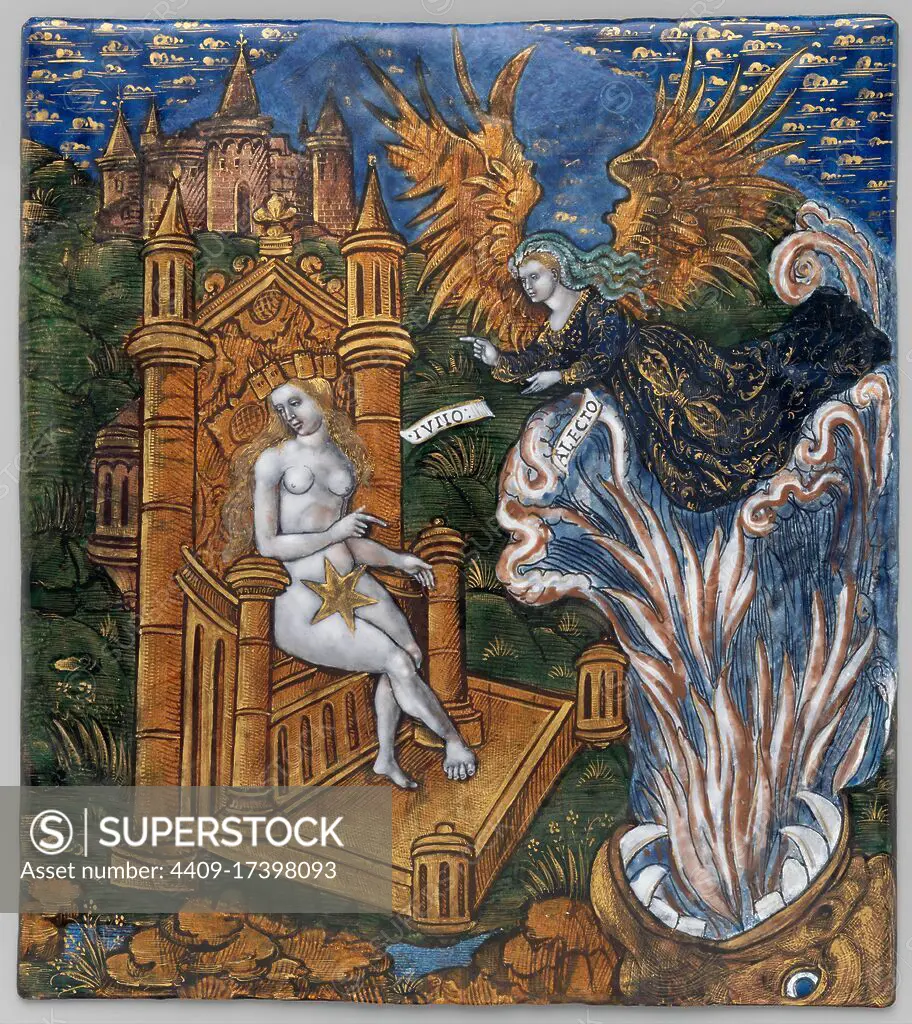
SuperStock offers millions of photos, videos, and stock assets to creatives around the world. This image of Juno, Seated on a Golden Throne, Asks Alecto to Confuse the Trojans (Aeneid, Book VI). Artist: Master of the Aeneid (active ca. 1530-40). Culture: French, Limoges. Dimensions: 9 x 8 in. (22.9 x 20.3 cm). Date: ca. 1530-35.European of the Renaissance period viewed ancient Rome not only as the origin of Italian civilzation but also the geographic center of a lost golden age. This plaque belongs to a series of at least eighty Limoges enamels illustrating events from Virgil's Aeneid. The Latin epic poem tells the story of the legendary hero Aeneas, who escaped the sack and burning of Troy by the Greeks and, after wandering for some time, settled in Italy, where his descendants founded Rome.The scenes are not, however, the product of the enameler's imagination; rather, they are close copies of the woodcut illustrations for the edition of the Latin poet's Opera printed by Johann Grüninger in Strasbourg in 1502. The same woodcuts were used again for the edition published in Lyon in 1517. The by Album/Album Archivo is available for licensing today.
Looking for a license?
Click here, and we'll help you find it! Questions? Just ask!
Click here, and we'll help you find it! Questions? Just ask!
DETAILS
Image Number: 4409-17398093Rights ManagedCredit Line:Album/Album Archivo/SuperStockCollection:Album Archivo Contributor:Album Model Release:NoProperty Release:NoResolution:3582×4022