Interior Hanging 19th century Fulani peoples () Large-scale textiles created south of the Sahara were generally intended as enhancements for domestic environments. The principal type of textile produced by Fulani weavers was a blanket woven of hand-spun sheep's wool, known as khasa, that primarily functioned to enclose and define a space for personal use. The present rare work is far more elaborate and ambitious than most in that genre, and its place of origin has not been possible to determine in the absence of documentation. indeed, although purchased in the 1870s in Ghana by Joseph Upton, a Boston merchant, it does not resemble cloth produced there. It most closely resembles textiles of the Fulani, who live along the bend of the Niger River; however, it also shares affinities with textiles of the Mende and Temne of Sierra Leone. Woven principally of cotton and in narrow strips, it has features that suggest relationships to both cotton- and wool-weaving traditions. So complex and re
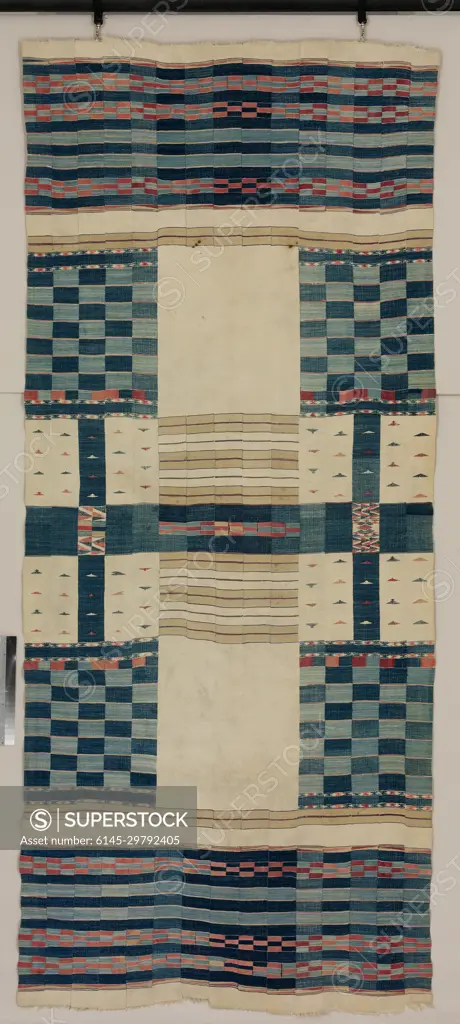
SuperStock offers millions of photos, videos, and stock assets to creatives around the world. This image of Interior Hanging 19th century Fulani peoples () Large-scale textiles created south of the Sahara were generally intended as enhancements for domestic environments. The principal type of textile produced by Fulani weavers was a blanket woven of hand-spun sheep's wool, known as khasa, that primarily functioned to enclose and define a space for personal use. The present rare work is far more elaborate and ambitious than most in that genre, and its place of origin has not been possible to determine in the absence of documentation. indeed, although purchased in the 1870s in Ghana by Joseph Upton, a Boston merchant, it does not resemble cloth produced there. It most closely resembles textiles of the Fulani, who live along the bend of the Niger River; however, it also shares affinities with textiles of the Mende and Temne of Sierra Leone. Woven principally of cotton and in narrow strips, it has features that suggest relationships to both cotton- and wool-weaving traditions. So complex and re by Piemags/PL Photography Limited is available for licensing today.
Looking for a license?
Click here, and we'll help you find it! Questions? Just ask!
Click here, and we'll help you find it! Questions? Just ask!
DETAILS
Image Number: 6145-29792405Royalty FreeCredit Line:Piemags/PL Photography Limited/SuperStockCollection:PL Photography Limited Contributor:Piemags Model Release:NoProperty Release:NoResolution:1798×4000