Incense Box with Scene from Noh Play Kokaji second half of the 19th century Koma School Japanese The cover and inside tray illustrate a famous Noh play based in the late tenth and early eleventh centuries. In the play, the emperor receives an oracle in a dream and the famous sword maker Kokaji forges a sword with the help of a Shinto deity. This deity appears as a fox; however, on the cover of the box, both figures are shown in human form. An inscription on the bottom of the box indicates that it was produced in the style of Koma Kansai II (1767-1835) by one of the many artists who worked in this tradition and often used the name of the original master.. Incense Box with Scene from Noh Play Kokaji. Koma School (Japanese). Japan. second half of the 19th century. Black lacquer with gold, silver, and red hiramaki-e and togidashimaki-e. Meiji period (1868-1912). Lacquer
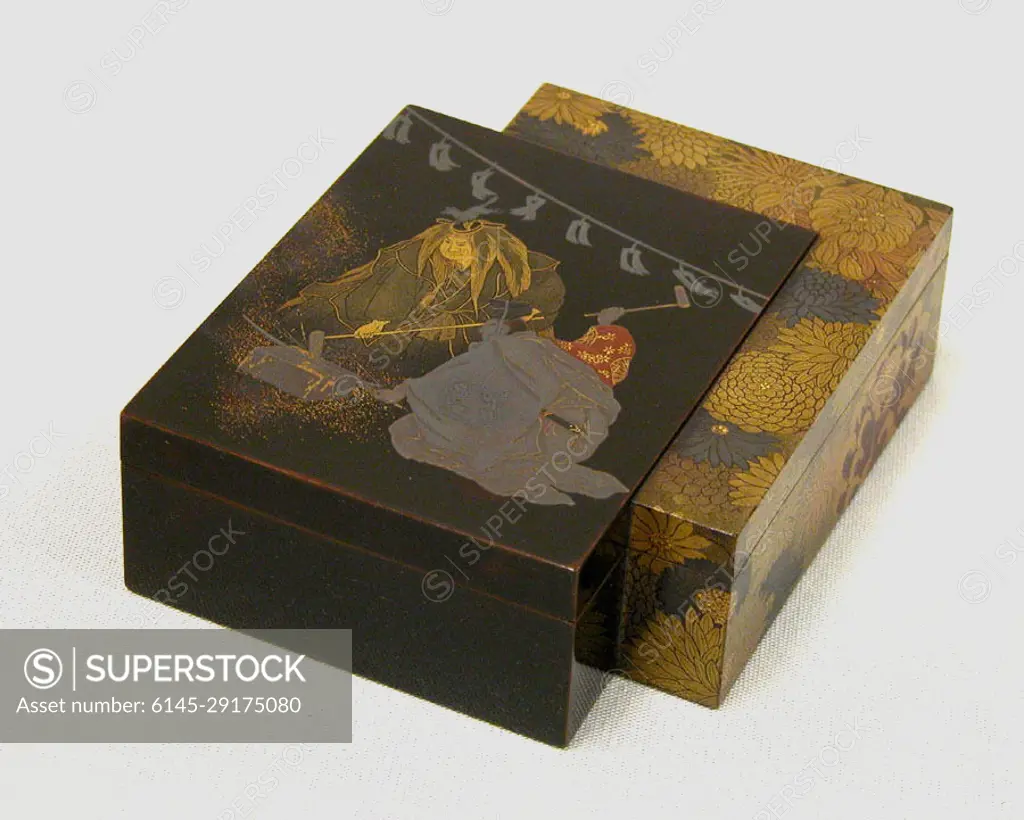
SuperStock offers millions of photos, videos, and stock assets to creatives around the world. This image of Incense Box with Scene from Noh Play Kokaji second half of the 19th century Koma School Japanese The cover and inside tray illustrate a famous Noh play based in the late tenth and early eleventh centuries. In the play, the emperor receives an oracle in a dream and the famous sword maker Kokaji forges a sword with the help of a Shinto deity. This deity appears as a fox; however, on the cover of the box, both figures are shown in human form. An inscription on the bottom of the box indicates that it was produced in the style of Koma Kansai II (1767-1835) by one of the many artists who worked in this tradition and often used the name of the original master.. Incense Box with Scene from Noh Play Kokaji. Koma School (Japanese). Japan. second half of the 19th century. Black lacquer with gold, silver, and red hiramaki-e and togidashimaki-e. Meiji period (1868-1912). Lacquer by Piemags/PL Photography Limited is available for licensing today.
Looking for a license?
Click here, and we'll help you find it! Questions? Just ask!
Click here, and we'll help you find it! Questions? Just ask!
DETAILS
Image Number: 6145-29175080Royalty FreeCredit Line:Piemags/PL Photography Limited/SuperStockCollection:PL Photography Limited Contributor:Piemags Model Release:NoProperty Release:NoResolution:900×721