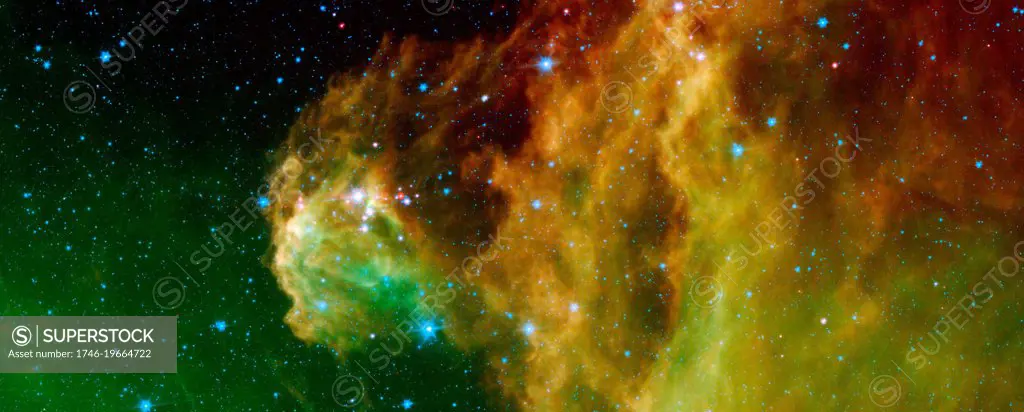
Image from NASAs Spitzer Space Telescope shows infant stars hatching in the head of the hunter constellation, Orion. Astronomers suspect that shockwaves from a supernova explosion in Orions head, nearly three million years ago, may have initiated this newfound birth. The region featured in this Spitzer image is called Barnard 30. It is located approximately 1,300 light-years away and sits on the right side of Orions head, just north of the massive star Lambda Orionis. Wisps of green in the cloud are organic molecules called polycyclic aromatic hydrocarbons. These molecules are formed anytime carbon-based materials are burned incompletely. On Earth, they can be found in the sooty exhaust from automobile and airplane engines. They also coat the grills where charcoal-broiled meats are cooked. Tints of orange-red in the cloud are dust particles warmed by the newly forming stars. The reddish-pink dots at the top of the cloud are very young stars embedded in a cocoon of cosmic gas and
SuperStock offers millions of photos, videos, and stock assets to creatives around the world. This image of Image from NASAs Spitzer Space Telescope shows infant stars hatching in the head of the hunter constellation, Orion. Astronomers suspect that shockwaves from a supernova explosion in Orions head, nearly three million years ago, may have initiated this newfound birth. The region featured in this Spitzer image is called Barnard 30. It is located approximately 1,300 light-years away and sits on the right side of Orions head, just north of the massive star Lambda Orionis. Wisps of green in the cloud are organic molecules called polycyclic aromatic hydrocarbons. These molecules are formed anytime carbon-based materials are burned incompletely. On Earth, they can be found in the sooty exhaust from automobile and airplane engines. They also coat the grills where charcoal-broiled meats are cooked. Tints of orange-red in the cloud are dust particles warmed by the newly forming stars. The reddish-pink dots at the top of the cloud are very young stars embedded in a cocoon of cosmic gas and by World History Archive/Image Asset Management is available for licensing today.
Looking for a license?
Click here, and we'll help you find it! Questions? Just ask!
Click here, and we'll help you find it! Questions? Just ask!
DETAILS
Image Number: 1746-19664722Rights ManagedCredit Line:World History Archive/Image Asset Management/SuperStockCollection:Image Asset Management Contributor:World History Archive Model Release:NoProperty Release:NoResolution:7000×2820