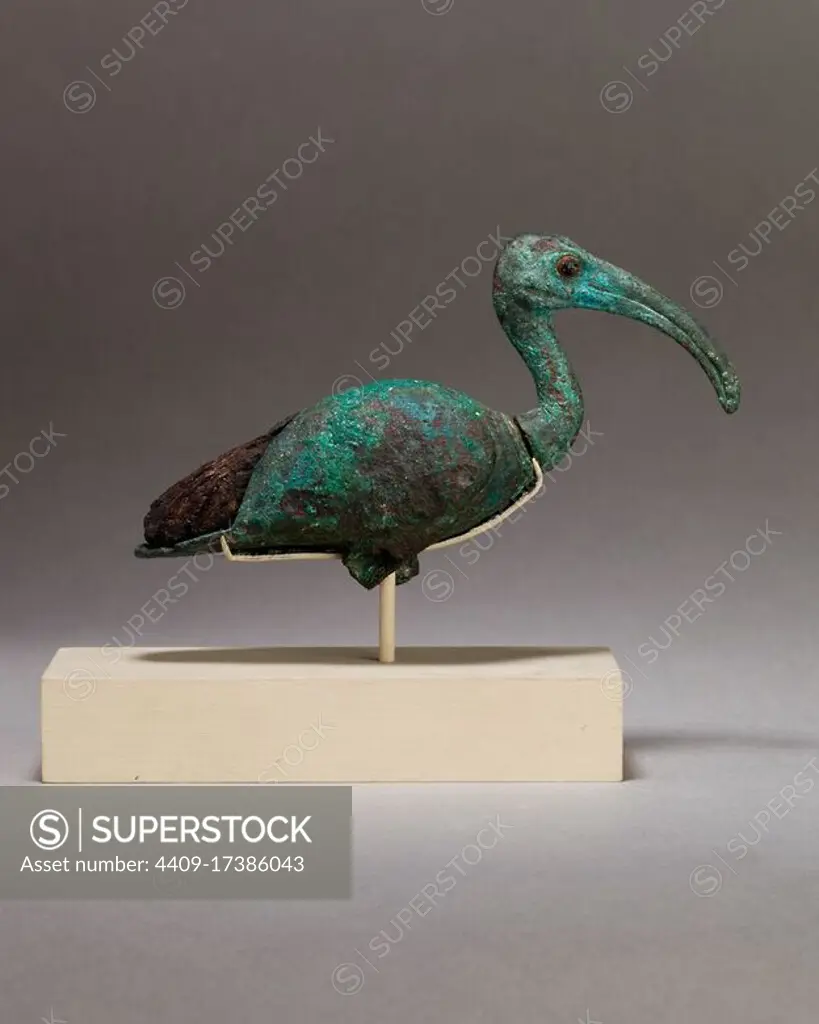
Ibis. Dimensions: H. 9 cm (3 9/16 in.); W. 4.4 cm (1 3/4 in.); L. 14.6 cm (5 3/4 in.). Date: 664-30 B.C..The ibis was sacred to Thoth, the god of wisdom, scribal functions, and learning. Representations of the ibis in copper alloy are some of the most numerous sacred animal statuettes, alongside the cat, falcon, and Apis bull. The prevalence of the ibis during the first millennium BC, and the appeal of animal cult in general, can also be seen in the thousands of surviving ibis mummies, which were offered in animal necropoleis (catacombs) throughout Egypt. This ibis is composed of multiple parts, including different materials. The head was separately crafted and is mechanically attached to the body. The legs, which were in a striding position (now lost), were also separately crafted. The tail feathers are made of wood, which would have contrasted nicely with the original shining cupreous metal patina. The technique of combining materials is well known for Egyptian statuary, and among
This asset has restrictions and cannot be purchased online. Get in touch for more details.
SuperStock offers millions of photos, videos, and stock assets to creatives around the world. This image of Ibis. Dimensions: H. 9 cm (3 9/16 in.); W. 4.4 cm (1 3/4 in.); L. 14.6 cm (5 3/4 in.). Date: 664-30 B.C..The ibis was sacred to Thoth, the god of wisdom, scribal functions, and learning. Representations of the ibis in copper alloy are some of the most numerous sacred animal statuettes, alongside the cat, falcon, and Apis bull. The prevalence of the ibis during the first millennium BC, and the appeal of animal cult in general, can also be seen in the thousands of surviving ibis mummies, which were offered in animal necropoleis (catacombs) throughout Egypt. This ibis is composed of multiple parts, including different materials. The head was separately crafted and is mechanically attached to the body. The legs, which were in a striding position (now lost), were also separately crafted. The tail feathers are made of wood, which would have contrasted nicely with the original shining cupreous metal patina. The technique of combining materials is well known for Egyptian statuary, and among by Album/Metropolitan Museum of Art, NY/Album Archivo is available for licensing today.
Looking for a license?
Click here, and we'll help you find it! Questions? Just ask!
Click here, and we'll help you find it! Questions? Just ask!
DETAILS
Image Number: 4409-17386043Rights ManagedCredit Line:Album/Metropolitan Museum of Art, NY/Album Archivo/SuperStockCollection:Album Archivo Contributor:Album / Metropolitan Museum of Art, NY Model Release:NoProperty Release:NoResolution:3360×4200