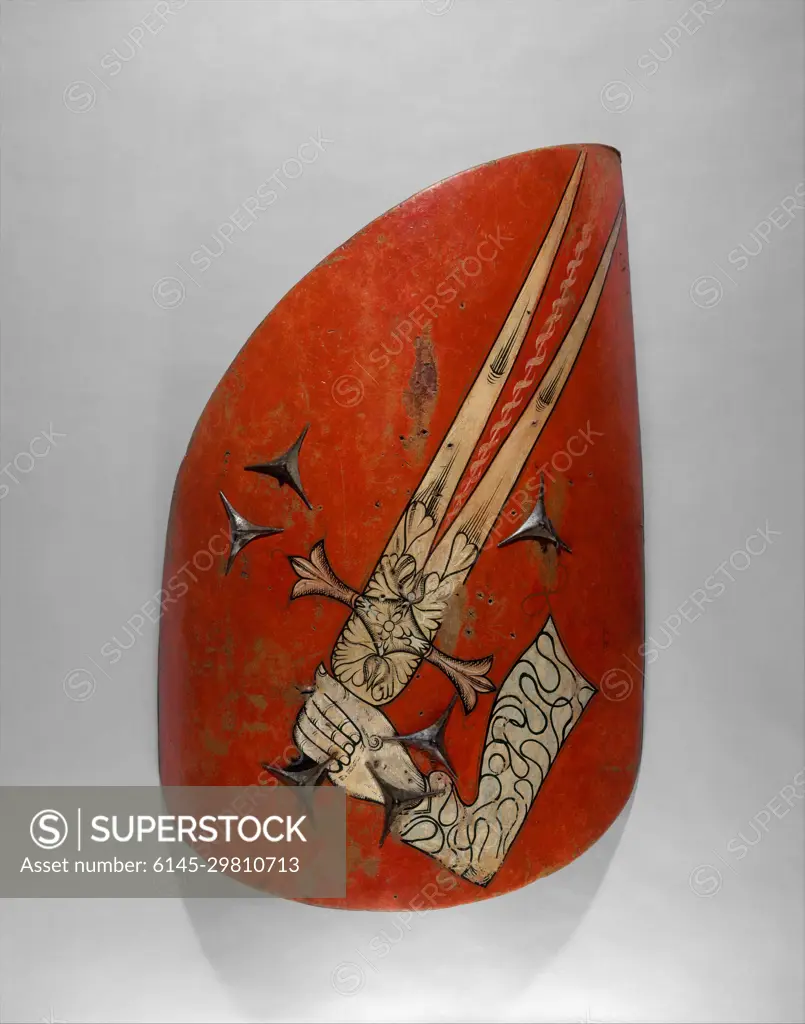
Hungarian-Style Shield ca. 1500-1550 Eastern European This wing-shaped shield and others like it in the Metropolitan Museum's collection (42.50.29, .30), with the distinctive upward-sweeping back edge, were the characteristic light-cavalry shields of Hungary. During the sixteenth century, the style was adopted across much of eastern Europe by both Christian and Islamic horsemen. The shield's elongated upper edge was designed to defend the back of the head and neck against cuts from a saber, the preferred cavalry weapon in that region.This shield is painted on its exterior with the double-bladed sword of the prophet Muhammad and on its interior with the Crucifix and instruments of the Passion. This unusual mix of Islamic and Christian symbols suggests that the shield was used in a tournament by a Christian warrior dressed in Muslim fashion. In these "Hungarian style" tournaments, the participants wore Hungarian and Turkish costumes and used sabers to strike off feathers attached to thei
SuperStock offers millions of photos, videos, and stock assets to creatives around the world. This image of Hungarian-Style Shield ca. 1500-1550 Eastern European This wing-shaped shield and others like it in the Metropolitan Museum's collection (42.50.29, .30), with the distinctive upward-sweeping back edge, were the characteristic light-cavalry shields of Hungary. During the sixteenth century, the style was adopted across much of eastern Europe by both Christian and Islamic horsemen. The shield's elongated upper edge was designed to defend the back of the head and neck against cuts from a saber, the preferred cavalry weapon in that region.This shield is painted on its exterior with the double-bladed sword of the prophet Muhammad and on its interior with the Crucifix and instruments of the Passion. This unusual mix of Islamic and Christian symbols suggests that the shield was used in a tournament by a Christian warrior dressed in Muslim fashion. In these "Hungarian style" tournaments, the participants wore Hungarian and Turkish costumes and used sabers to strike off feathers attached to thei by Piemags/PL Photography Limited is available for licensing today.
Looking for a license?
Click here, and we'll help you find it! Questions? Just ask!
Click here, and we'll help you find it! Questions? Just ask!
DETAILS
Image Number: 6145-29810713Royalty FreeCredit Line:Piemags/PL Photography Limited/SuperStockCollection:PL Photography Limited Contributor:Piemags Model Release:NoProperty Release:NoResolution:2926×3722