Hip-joint armchair (sillón de cadera or jamuga) ca. 1480-1500 Spanish, Granada This armchair consists of four S-shaped supports on two runner-like stands. The disks that join two of the supports at front and two at back suggest that the chair can be folded up like a pair of scissors. This is not possible, however. The supports will collide above the turning point, allowing only a small degree of movement. This impractical arrangement can easily be explained by the chair's derivation. It descends from the sella curulis, or curule chair, an ancient Roman folding seat used by consuls and high officials. In its elegant medieval interpretation, the throne-like chairby then called a faldistoriumcontinued to symbolize secular power, and as the customary seat of the higher clergy, it also came to express the authority of the church.[1 The folding mechanism was eventually eliminated, and the place where the joint had been was marked with an ornamented disk.By the late fifteenth century the s
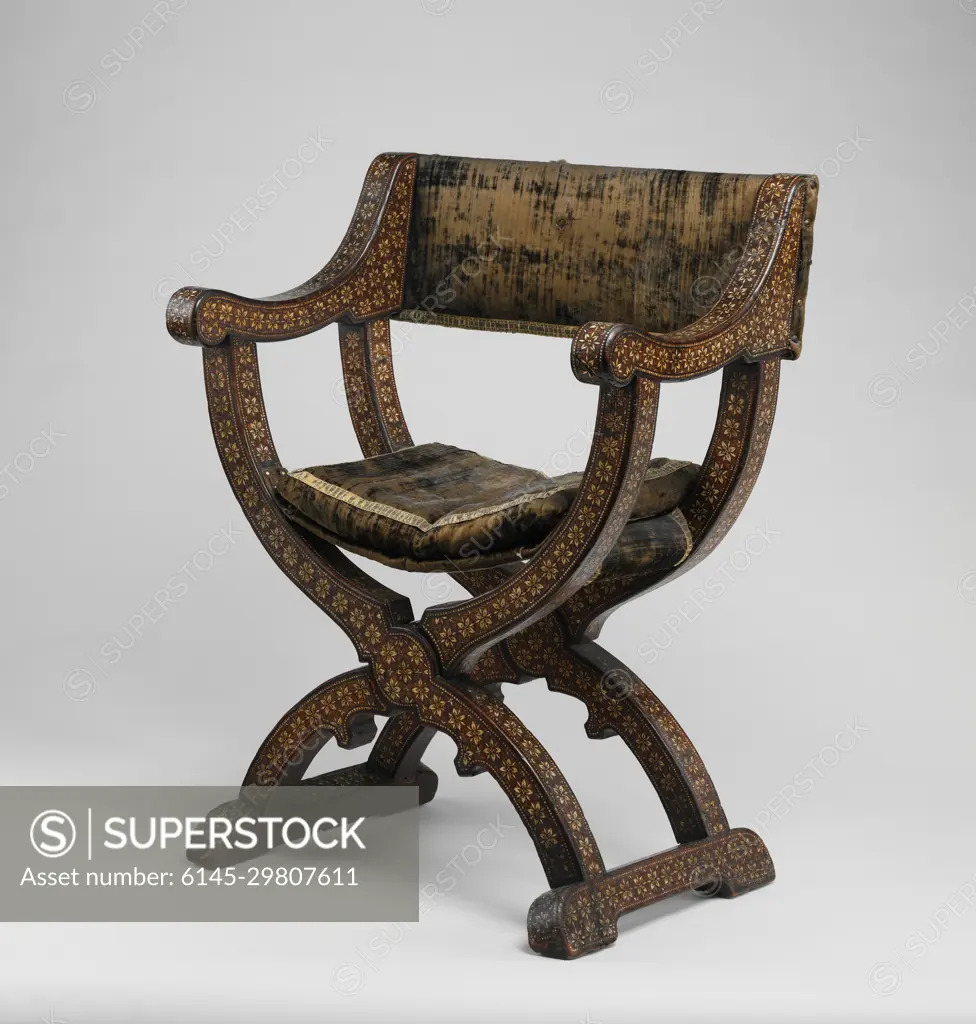
SuperStock offers millions of photos, videos, and stock assets to creatives around the world. This image of Hip-joint armchair (sillón de cadera or jamuga) ca. 1480-1500 Spanish, Granada This armchair consists of four S-shaped supports on two runner-like stands. The disks that join two of the supports at front and two at back suggest that the chair can be folded up like a pair of scissors. This is not possible, however. The supports will collide above the turning point, allowing only a small degree of movement. This impractical arrangement can easily be explained by the chair's derivation. It descends from the sella curulis, or curule chair, an ancient Roman folding seat used by consuls and high officials. In its elegant medieval interpretation, the throne-like chairby then called a faldistoriumcontinued to symbolize secular power, and as the customary seat of the higher clergy, it also came to express the authority of the church.[1 The folding mechanism was eventually eliminated, and the place where the joint had been was marked with an ornamented disk.By the late fifteenth century the s by Piemags/PL Photography Limited is available for licensing today.
Looking for a license?
Click here, and we'll help you find it! Questions? Just ask!
Click here, and we'll help you find it! Questions? Just ask!
DETAILS
Image Number: 6145-29807611Royalty FreeCredit Line:Piemags/PL Photography Limited/SuperStockCollection:PL Photography Limited Contributor:Piemags Model Release:NoProperty Release:NoResolution:3815×4000