Hevajra Mandala. Culture: Tibet. Dimensions: Image: 21 1/2 × 17 1/2 in. (54.6 × 44.5 cm)Framed: 28 1/2 × 24 1/2 in. (72.4 × 62.2 cm). Date: 15th century.Hevajra appears here in his three-headed and four-armed form. This manifestation is drawn from the Hevajra Tantra, a text revered by the Sakya School of Tibetan Buddhism, possibly the patrons of this painting. Hevajra and his consort Nairatmya dance at the intersection of four vajra gateways, indicating their position at the center of the cosmos. Hevajra's name is composed of two syllables, "he," compassion, representing the male aspect, and "Vajra," wisdom, the female aspect, which together offer the path beyond the illusory world. The repeating skull symbolism references death and the impermanence of all phenomena. Beyond the celestial palace are the eight great charnel grounds, each presided over by a yogic master, or mahasiddha. On the reverse are inscriptions in an ornate Tibetan lantsa script of the Sanskrit mantra OH AH HUM an
This asset has restrictions and cannot be purchased online. Get in touch for more details.
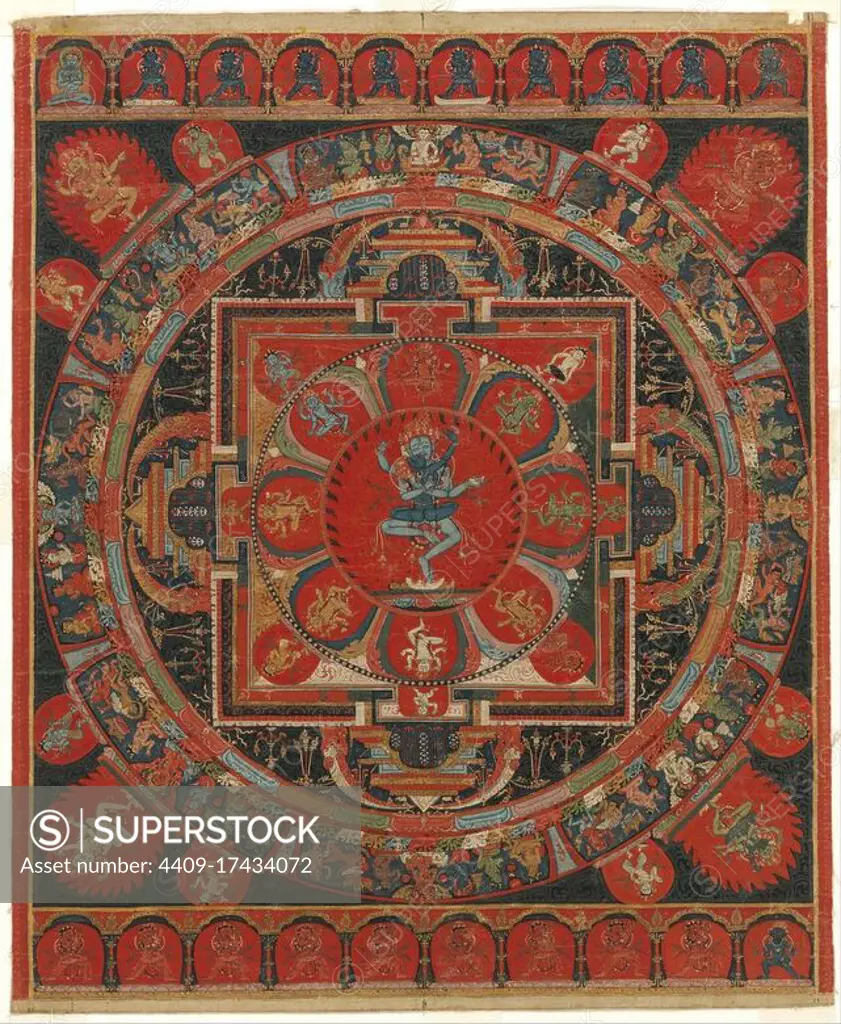
SuperStock offers millions of photos, videos, and stock assets to creatives around the world. This image of Hevajra Mandala. Culture: Tibet. Dimensions: Image: 21 1/2 × 17 1/2 in. (54.6 × 44.5 cm)Framed: 28 1/2 × 24 1/2 in. (72.4 × 62.2 cm). Date: 15th century.Hevajra appears here in his three-headed and four-armed form. This manifestation is drawn from the Hevajra Tantra, a text revered by the Sakya School of Tibetan Buddhism, possibly the patrons of this painting. Hevajra and his consort Nairatmya dance at the intersection of four vajra gateways, indicating their position at the center of the cosmos. Hevajra's name is composed of two syllables, "he," compassion, representing the male aspect, and "Vajra," wisdom, the female aspect, which together offer the path beyond the illusory world. The repeating skull symbolism references death and the impermanence of all phenomena. Beyond the celestial palace are the eight great charnel grounds, each presided over by a yogic master, or mahasiddha. On the reverse are inscriptions in an ornate Tibetan lantsa script of the Sanskrit mantra OH AH HUM an by Album/Metropolitan Museum of Art, NY/Album Archivo is available for licensing today.
Looking for a license?
Click here, and we'll help you find it! Questions? Just ask!
Click here, and we'll help you find it! Questions? Just ask!
DETAILS
Image Number: 4409-17434072Rights ManagedCredit Line:Album/Metropolitan Museum of Art, NY/Album Archivo/SuperStockCollection:Album Archivo Contributor:Album / Metropolitan Museum of Art, NY Model Release:NoProperty Release:NoResolution:3344×4067