Helmet in the Shape of a Crouching Rabbit 17th century Japanese The sixteenth century marked a period in Japanese history that was disrupted by political upheavel, warlordism, and near constant military conflicts, bringing significant changes in the way battles were fought. One such change was the employment of armies that were larger than ever before, a fact which also increased the number of participating units. Thus, the use of standards, banners, and any form of identifier became essential. Higher ranking samurai also wanted to stand out so that their military achievements would be noticed on the battlefield. This trend gave rise, i.a., to the highly individualized helmet form of the kawari-kabuto.The entire cranial portion of this kawari-kabuto is made from one piece of iron and shaped to represent a crouching rabbit, a technique referred to as ichimai-uchidashi. The unlacquered iron is beautifully contrasted with a neckguard (shikoro) of four rows, three of which are lacquered re
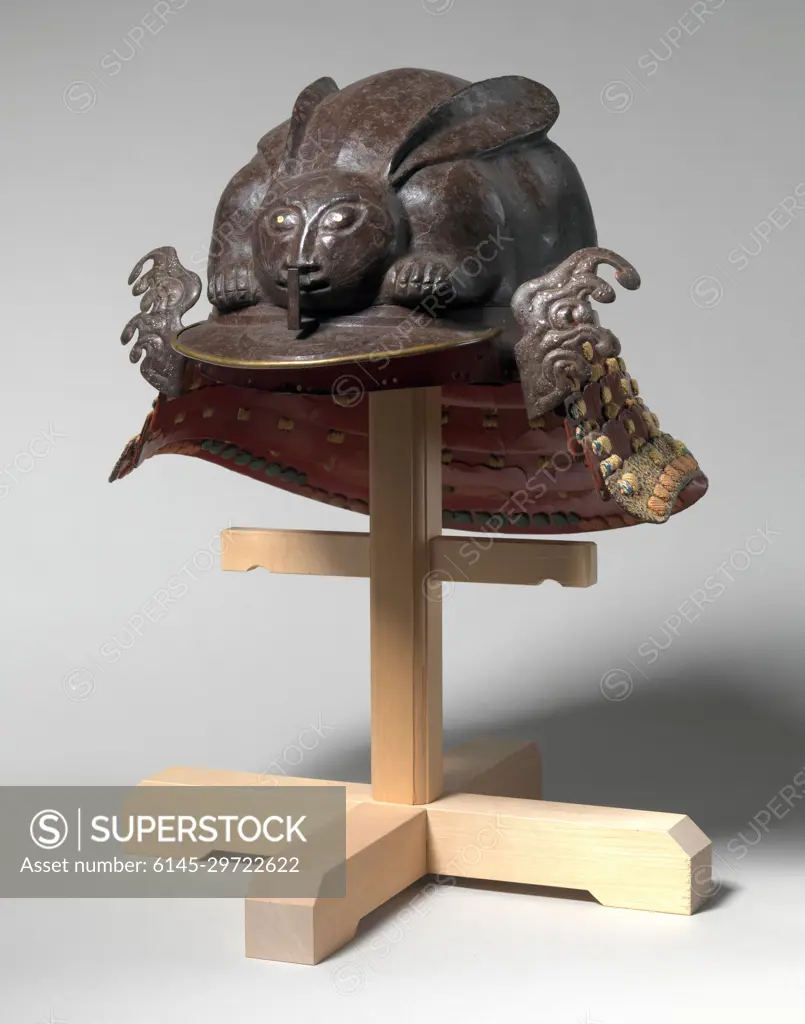
SuperStock offers millions of photos, videos, and stock assets to creatives around the world. This image of Helmet in the Shape of a Crouching Rabbit 17th century Japanese The sixteenth century marked a period in Japanese history that was disrupted by political upheavel, warlordism, and near constant military conflicts, bringing significant changes in the way battles were fought. One such change was the employment of armies that were larger than ever before, a fact which also increased the number of participating units. Thus, the use of standards, banners, and any form of identifier became essential. Higher ranking samurai also wanted to stand out so that their military achievements would be noticed on the battlefield. This trend gave rise, i.a., to the highly individualized helmet form of the kawari-kabuto.The entire cranial portion of this kawari-kabuto is made from one piece of iron and shaped to represent a crouching rabbit, a technique referred to as ichimai-uchidashi. The unlacquered iron is beautifully contrasted with a neckguard (shikoro) of four rows, three of which are lacquered re by Piemags/PL Photography Limited is available for licensing today.
Looking for a license?
Click here, and we'll help you find it! Questions? Just ask!
Click here, and we'll help you find it! Questions? Just ask!
DETAILS
Image Number: 6145-29722622Royalty FreeCredit Line:Piemags/PL Photography Limited/SuperStockCollection:PL Photography Limited Contributor:Piemags Model Release:NoProperty Release:NoResolution:3147×4000