Handkerchief second half 19th century Possibly designed by Emma Radford British Emma Radford was a prize-winning lacemaker and designer in her native Devon. Devonshire bobbin lace, commonly known as Honiton lace, comprised individual motifs that were later joined together. Queen Victoria chose Honiton lace for her wedding ensemble in 1840, leading to a boom in its popularity in the mid-nineteenth century. Philanthropists of the period were intent on increasing sales of handmade lace to alleviate the poverty of lacemakers. This movement coincided with the development of a new and uniquely English style of lace that incorporated motifs of highly naturalistic flowers, birds, and insects. The techniques developed to craft three-dimensional effects such as those seen in this piece, sometimes called raised work, were a specialty of Honiton lace workers.. Handkerchief 218374
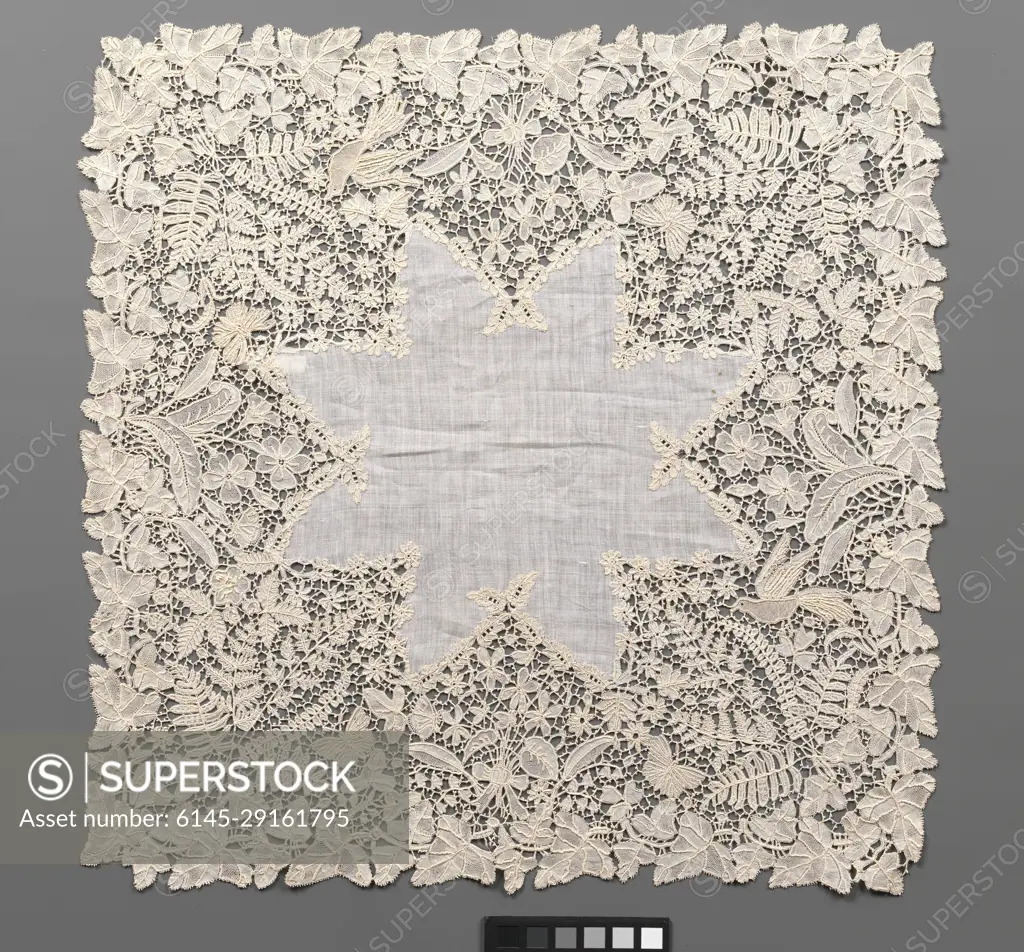
SuperStock offers millions of photos, videos, and stock assets to creatives around the world. This image of Handkerchief second half 19th century Possibly designed by Emma Radford British Emma Radford was a prize-winning lacemaker and designer in her native Devon. Devonshire bobbin lace, commonly known as Honiton lace, comprised individual motifs that were later joined together. Queen Victoria chose Honiton lace for her wedding ensemble in 1840, leading to a boom in its popularity in the mid-nineteenth century. Philanthropists of the period were intent on increasing sales of handmade lace to alleviate the poverty of lacemakers. This movement coincided with the development of a new and uniquely English style of lace that incorporated motifs of highly naturalistic flowers, birds, and insects. The techniques developed to craft three-dimensional effects such as those seen in this piece, sometimes called raised work, were a specialty of Honiton lace workers.. Handkerchief 218374 by Piemags/PL Photography Limited is available for licensing today.
Looking for a license?
Click here, and we'll help you find it! Questions? Just ask!
Click here, and we'll help you find it! Questions? Just ask!
DETAILS
Image Number: 6145-29161795Royalty FreeCredit Line:Piemags/PL Photography Limited/SuperStockCollection:PL Photography Limited Contributor:Piemags Model Release:NoProperty Release:NoResolution:2000×1860