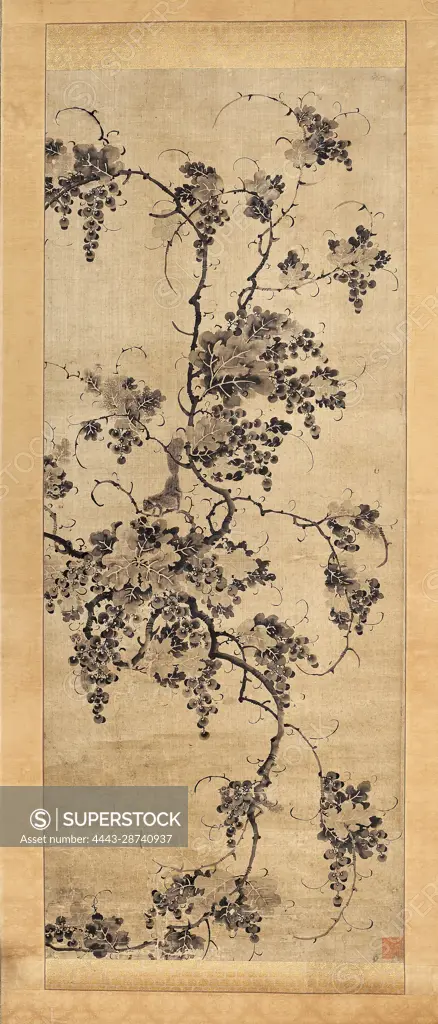
Grapevine and Squirrels, 18th-19th century, Unknown Japanese, 56 × 22 1/2 in. (142.24 × 57.15 cm) (image), Ink on silk, Japan, 18th-19th century, The Chinese monk artist Tzu-wen Jih-kuan first popularized ink monochrome paintings of grapes during the 13th century. The twisting vines, curling tendrils and round, plump grapes provided ample opportunity for expressive 'brush play.' They may also have been painting to express the scholar-artist's fondness for wine. The combination of squirrels and grapevines, as seen here, is actually a rebus, or word pun. In Korean, the word for 'squirrel' sounds like 'pine,' and the word for 'grape' sounds like 'peach.' Since pines and peaches are longstanding symbols of long life in China and Korea, squirrels and grapes, when pronounced, is a playful wish for continued good health.
SuperStock offers millions of photos, videos, and stock assets to creatives around the world. This image of Grapevine and Squirrels, 18th-19th century, Unknown Japanese, 56 × 22 1/2 in. (142.24 × 57.15 cm) (image), Ink on silk, Japan, 18th-19th century, The Chinese monk artist Tzu-wen Jih-kuan first popularized ink monochrome paintings of grapes during the 13th century. The twisting vines, curling tendrils and round, plump grapes provided ample opportunity for expressive 'brush play.' They may also have been painting to express the scholar-artist's fondness for wine. The combination of squirrels and grapevines, as seen here, is actually a rebus, or word pun. In Korean, the word for 'squirrel' sounds like 'pine,' and the word for 'grape' sounds like 'peach.' Since pines and peaches are longstanding symbols of long life in China and Korea, squirrels and grapes, when pronounced, is a playful wish for continued good health. by Artokoloro is available for licensing today.
Looking for a license?
Click here, and we'll help you find it! Questions? Just ask!
Click here, and we'll help you find it! Questions? Just ask!
DETAILS
Image Number: 4443-28740937Rights ManagedCredit Line:Artokoloro/SuperStockCollection:Artokoloro Model Release:NoProperty Release:NoResolution:2278×5316