Gold phiale (libation bowl) 4th-3rd century B.C. Greek Inscribed on the base sketchily in Greek, "Pausi ," and more deeply engraved in Punic (Carthaginian) characters, an indication of weightThis libation bowl, decorated with bees, acorns, and beechnuts, is worked in repoussé. Phialai decorated with acorns were being made by the late sixth century B.C. and must have been traditional. Acorns could also be seen on the phialai held by the caryatids of the Erechtheum on the Akropolis in Athens, as we learn from Roman copies found in Hadrian's villa at Tivoli. Listen to experts illuminate this artwork's story Listen Play or pause #1225. Gold phiale (libation bowl) Supported by Bloomberg Philanthropies We're sorry, the transcript for this audio track is not available at this time. We are working to make it available as soon as possible.. Gold phiale (libation bowl) 255122
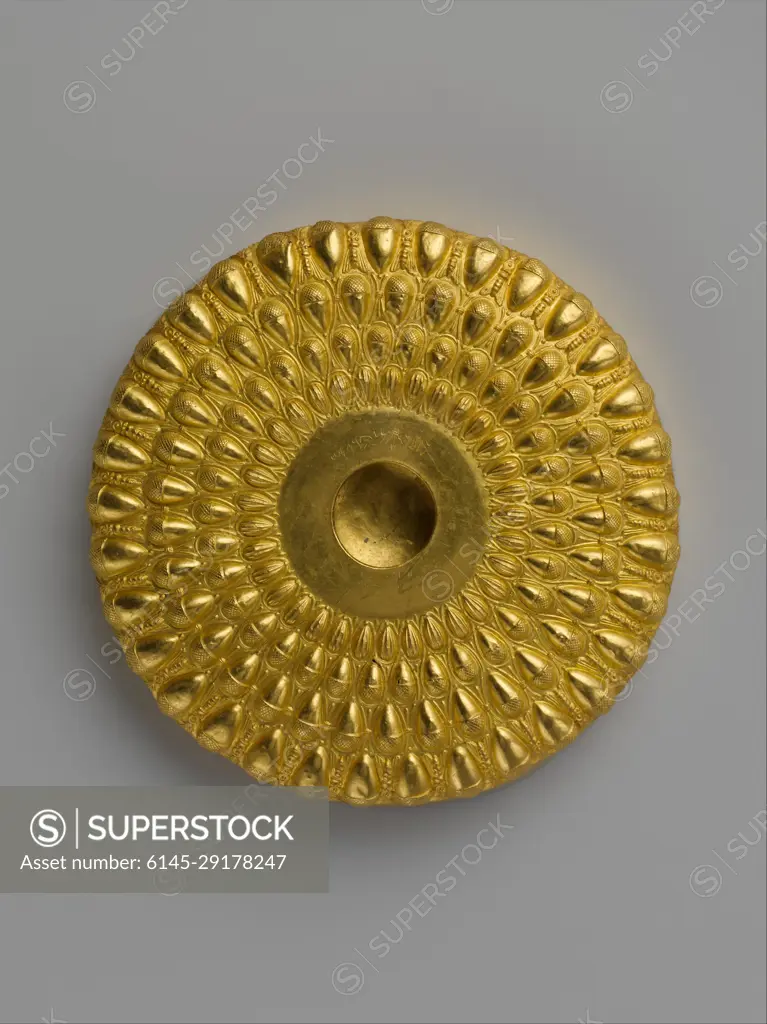
SuperStock offers millions of photos, videos, and stock assets to creatives around the world. This image of Gold phiale (libation bowl) 4th-3rd century B.C. Greek Inscribed on the base sketchily in Greek, "Pausi ," and more deeply engraved in Punic (Carthaginian) characters, an indication of weightThis libation bowl, decorated with bees, acorns, and beechnuts, is worked in repoussé. Phialai decorated with acorns were being made by the late sixth century B.C. and must have been traditional. Acorns could also be seen on the phialai held by the caryatids of the Erechtheum on the Akropolis in Athens, as we learn from Roman copies found in Hadrian's villa at Tivoli. Listen to experts illuminate this artwork's story Listen Play or pause #1225. Gold phiale (libation bowl) Supported by Bloomberg Philanthropies We're sorry, the transcript for this audio track is not available at this time. We are working to make it available as soon as possible.. Gold phiale (libation bowl) 255122 by Piemags/PL Photography Limited is available for licensing today.
Looking for a license?
Click here, and we'll help you find it! Questions? Just ask!
Click here, and we'll help you find it! Questions? Just ask!
DETAILS
Image Number: 6145-29178247Royalty FreeCredit Line:Piemags/PL Photography Limited/SuperStockCollection:PL Photography Limited Contributor:Piemags Model Release:NoProperty Release:NoResolution:2881×3842