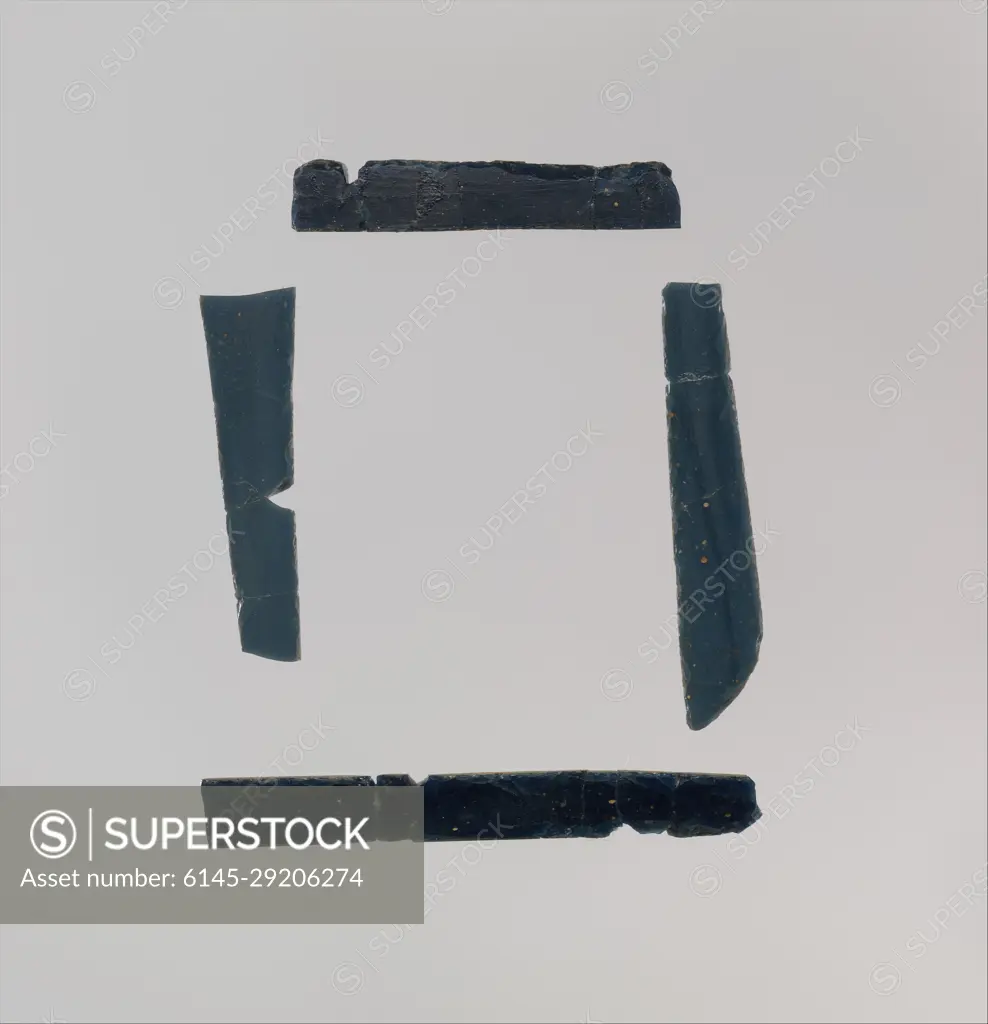
Furniture elements ca. 9th-8th century B.C. Assyrian These dark blue strips of glass were found at Arslan Tash, together with a large group of carved ivory furniture inlays. The color of these pieces suggests that a metal ore such as copper or cobalt was added to the glass matrix. They may have been intended to imitate lapis lazuli, a dark blue semiprecious stone mined in northeastern Afghanistan that was prized by the Assyrians. These pieces were probably manufactured by Phoenician craftsmen who were expert at inlaying glass into ivories. Two pieces take the shape of long feathers, although the tip of one does not survive. These pieces may have been inlaid into cloisons (walled cells) within the wing of a fantastic creature such as a sphinx on a carved ivory furniture inlay, which was then joined to a piece of wooden furniture. The two rectangular strips may have been set directly into a piece of furniture.Arslan Tash, ancient Hadatu, was an Aramaean town located in northern Syria jus
SuperStock offers millions of photos, videos, and stock assets to creatives around the world. This image of Furniture elements ca. 9th-8th century B.C. Assyrian These dark blue strips of glass were found at Arslan Tash, together with a large group of carved ivory furniture inlays. The color of these pieces suggests that a metal ore such as copper or cobalt was added to the glass matrix. They may have been intended to imitate lapis lazuli, a dark blue semiprecious stone mined in northeastern Afghanistan that was prized by the Assyrians. These pieces were probably manufactured by Phoenician craftsmen who were expert at inlaying glass into ivories. Two pieces take the shape of long feathers, although the tip of one does not survive. These pieces may have been inlaid into cloisons (walled cells) within the wing of a fantastic creature such as a sphinx on a carved ivory furniture inlay, which was then joined to a piece of wooden furniture. The two rectangular strips may have been set directly into a piece of furniture.Arslan Tash, ancient Hadatu, was an Aramaean town located in northern Syria jus by Piemags/PL Photography Limited is available for licensing today.
Looking for a license?
Click here, and we'll help you find it! Questions? Just ask!
Click here, and we'll help you find it! Questions? Just ask!
DETAILS
Image Number: 6145-29206274Royalty FreeCredit Line:Piemags/PL Photography Limited/SuperStockCollection:PL Photography Limited Contributor:Piemags Model Release:NoProperty Release:NoResolution:3690×3824