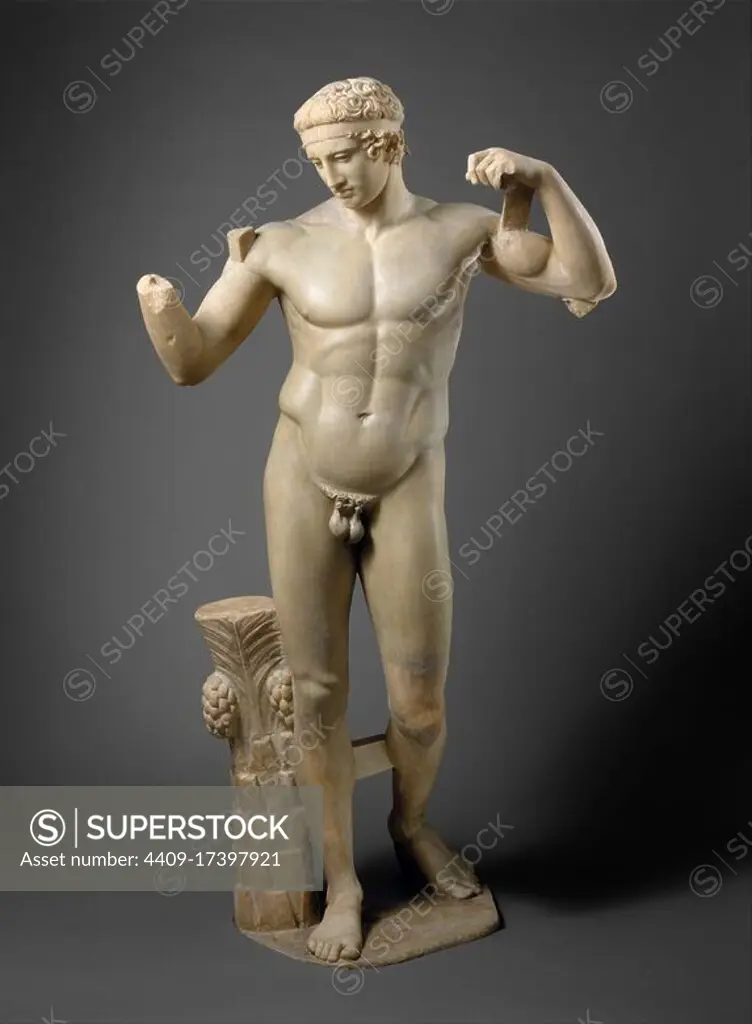
Fragments of a marble statue of the Diadoumenos (youth tying a fillet around his head). Culture: Roman. Dimensions: H. 73 in. (185.4 cm). Date: ca. A.D. 69-96.Head, arms, and legs from the knees down, and tree trunk are ancient. Remainder of the figure is a cast taken from a marble copy found at Delos and now in the Nation Museum, Athens.This statue represents a youth adorning his head with a fillet (band) after victory in an athletic contest. The original bronze probably stood in a sanctuary such as that at Olympia or Delphi, where games were regularly held. The Greek sculptor Polykleitos of Argos, who worked during the mid-fifth century B.C., was one of the most famous artists of the ancient world. His figures are carefully designed with special attention to bodily proportions and stance. The figure's thorax and pelvis tilt in opposite directions, setting up rhythmic contrasts in the torso that create an impression of organic vitality. The position of the feet--poised between stand
This asset has restrictions and cannot be purchased online. Get in touch for more details.
SuperStock offers millions of photos, videos, and stock assets to creatives around the world. This image of Fragments of a marble statue of the Diadoumenos (youth tying a fillet around his head). Culture: Roman. Dimensions: H. 73 in. (185.4 cm). Date: ca. A.D. 69-96.Head, arms, and legs from the knees down, and tree trunk are ancient. Remainder of the figure is a cast taken from a marble copy found at Delos and now in the Nation Museum, Athens.This statue represents a youth adorning his head with a fillet (band) after victory in an athletic contest. The original bronze probably stood in a sanctuary such as that at Olympia or Delphi, where games were regularly held. The Greek sculptor Polykleitos of Argos, who worked during the mid-fifth century B.C., was one of the most famous artists of the ancient world. His figures are carefully designed with special attention to bodily proportions and stance. The figure's thorax and pelvis tilt in opposite directions, setting up rhythmic contrasts in the torso that create an impression of organic vitality. The position of the feet--poised between stand by Album/Metropolitan Museum of Art, NY/Album Archivo is available for licensing today.
Looking for a license?
Click here, and we'll help you find it! Questions? Just ask!
Click here, and we'll help you find it! Questions? Just ask!
DETAILS
Image Number: 4409-17397921Rights ManagedCredit Line:Album/Metropolitan Museum of Art, NY/Album Archivo/SuperStockCollection:Album Archivo Contributor:Album / Metropolitan Museum of Art, NY Model Release:NoProperty Release:NoResolution:3006×4094