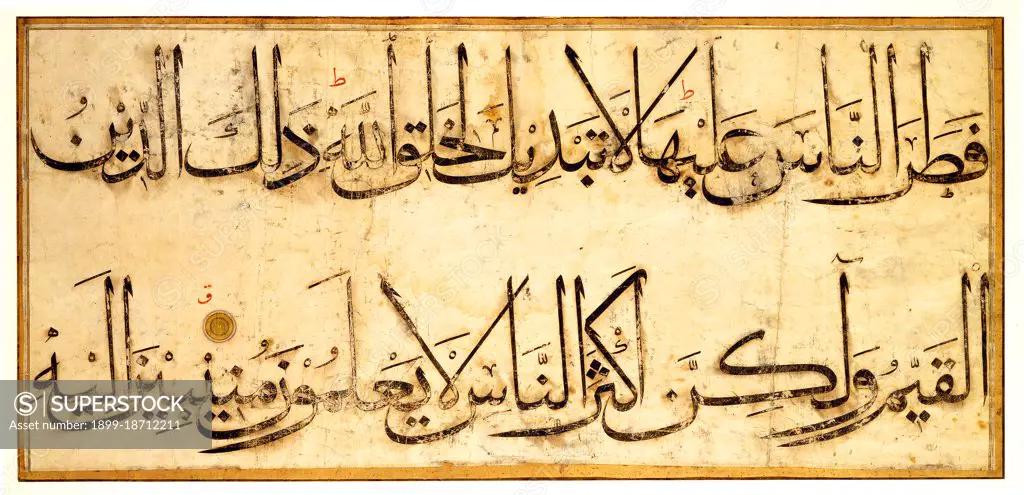
Fragment of a leaf from the great Qur'an of Samarkand. These two lines are a fragment of a leaf from the largest known Koran ever made. Each leaf had seven lines, and the leaf would have measured 222 × 155 cm untrimmed. The Koran was copied by Umar Aqta for the world conqueror Timur (Tamerlane) in his capital of Samarkand. Transcribing a Qur'an in this format must have demanded enormous concentration of the calligrapher, and the exactitude and elegance with which the gigantic script - Jalil Muhaqqaq - was written make it a masterpiece in its genre. The point of the reed pen must have measured c. 1 cm, and making the large sheets of paper must have been a technological accomplishment in itself.
SuperStock offers millions of photos, videos, and stock assets to creatives around the world. This image of Fragment of a leaf from the great Qur'an of Samarkand. These two lines are a fragment of a leaf from the largest known Koran ever made. Each leaf had seven lines, and the leaf would have measured 222 × 155 cm untrimmed. The Koran was copied by Umar Aqta for the world conqueror Timur (Tamerlane) in his capital of Samarkand. Transcribing a Qur'an in this format must have demanded enormous concentration of the calligrapher, and the exactitude and elegance with which the gigantic script - Jalil Muhaqqaq - was written make it a masterpiece in its genre. The point of the reed pen must have measured c. 1 cm, and making the large sheets of paper must have been a technological accomplishment in itself. by Pictures From History/Universal Images is available for licensing today.
Looking for a license?
Click here, and we'll help you find it! Questions? Just ask!
Click here, and we'll help you find it! Questions? Just ask!
DETAILS
Image Number: 1899-18712211Rights ManagedCredit Line:Pictures From History/Universal Images/SuperStockCollection:Universal Images Contributor:Pictures From History Model Release:NoProperty Release:NoResolution:6000×2905