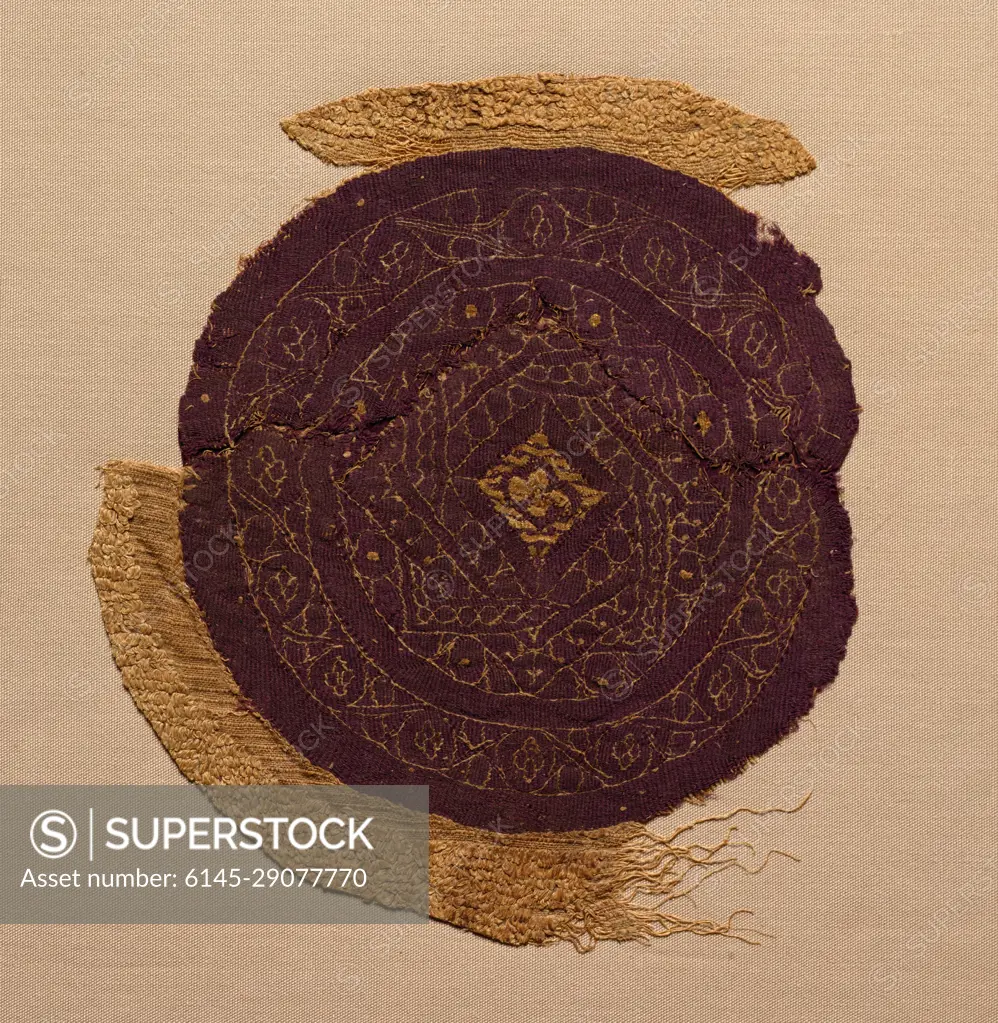
Fragment with Gold Foil and Apotropaic Interlacing Knots, 300s-400s. Egypt, Byzantine period, 4th-5th century. Undyed linen, dyed wool, and gold foil; plain weave with supplementary weft-loops, slit-tapestry weave with supplementary weft wrapping; overall: 20.4 x 18.5 cm (8 1/16 x 7 5/16 in.); mounted: 33 x 33 cm (13 x 13 in.). The rare gold foil and rich purple wool in these two fragments originally enriched a luxurious fabric. Costly gold foil wrapped around a silk core forms the central motif within a diamond, woven in tapestry weave. The surrounding interlacing knot designachieved with three overlapping squares (in the small fragment) or interlacing squares (in the large fragment)offered protection from danger and harm. The roundels were woven with extra, or supplementary, linen wefts wrapped on the purple ground. Linen pile loops in the ground fabric resisted abrasion in furnishing fabrics and provided insulation in tunics.
SuperStock offers millions of photos, videos, and stock assets to creatives around the world. This image of Explore Ancient Egyptian Textile Art: Intricately Designed Tapestry from a Historical Roman-Egyptian Context by Piemags/PL Photography Limited is available for licensing today.
Looking for a license?
Click here, and we'll help you find it! Questions? Just ask!
Click here, and we'll help you find it! Questions? Just ask!
DETAILS
Image Number: 6145-29077770Royalty FreeCredit Line:Piemags/PL Photography Limited/SuperStockCollection:PL Photography Limited Contributor:Piemags Model Release:NoProperty Release:NoResolution:3315×3400