Four Seasons shawl mid-19th century French or Scottish A shawl was a required fashion accessory during much of the nineteenth century. In the early 1800s long, rectangular, stolelike examples, hand-woven in India with boteh (pine cone) or paisley patterned end panels, were coveted for use with Empire-style dresses. This style was followed by the square shawl and then, with the introduction of wider skirts, by "plaids"a term used not to describe the pattern but to connote a very large and long shawl, usually ten feet by five feet.Stylistically, this shawl demonstrates both a "four seasons" layoutin which the ground color is different in each of the quadrantsand an organization a la pivot, indicating the manner in which the vegetation swirls around a central point. The design for the shawl is probably French, but it may have been purchased by a Scottish manufacturer and jacquard-woven in Paisley.[Alice Zrebiec, 1995. Four Seasons shawl 195475
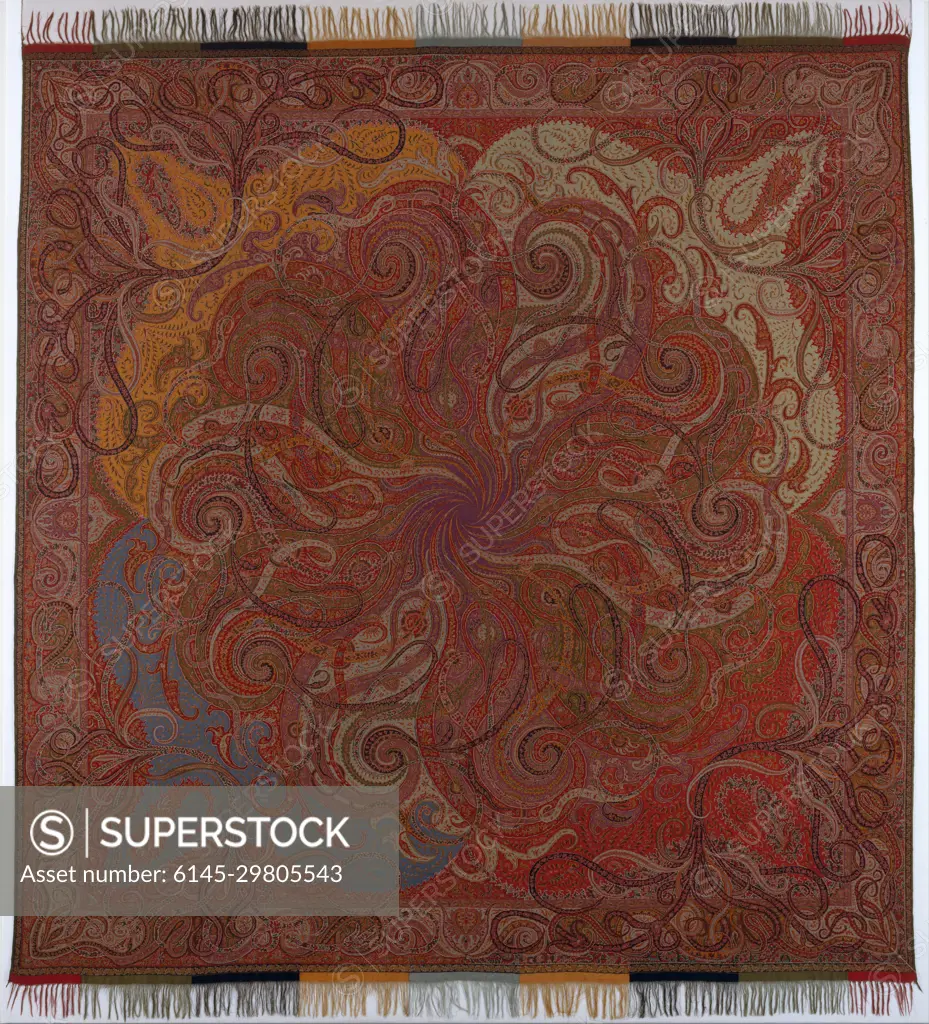
SuperStock offers millions of photos, videos, and stock assets to creatives around the world. This image of Four Seasons shawl mid-19th century French or Scottish A shawl was a required fashion accessory during much of the nineteenth century. In the early 1800s long, rectangular, stolelike examples, hand-woven in India with boteh (pine cone) or paisley patterned end panels, were coveted for use with Empire-style dresses. This style was followed by the square shawl and then, with the introduction of wider skirts, by "plaids"a term used not to describe the pattern but to connote a very large and long shawl, usually ten feet by five feet.Stylistically, this shawl demonstrates both a "four seasons" layoutin which the ground color is different in each of the quadrantsand an organization a la pivot, indicating the manner in which the vegetation swirls around a central point. The design for the shawl is probably French, but it may have been purchased by a Scottish manufacturer and jacquard-woven in Paisley.[Alice Zrebiec, 1995. Four Seasons shawl 195475 by Piemags/PL Photography Limited is available for licensing today.
Looking for a license?
Click here, and we'll help you find it! Questions? Just ask!
Click here, and we'll help you find it! Questions? Just ask!
DETAILS
Image Number: 6145-29805543Royalty FreeCredit Line:Piemags/PL Photography Limited/SuperStockCollection:PL Photography Limited Contributor:Piemags Model Release:NoProperty Release:NoResolution:3345×3687