Footed beaker mid-17th century Possibly by Thomas Trepches II The proximity of Hungary to the Ottoman Empire may explain why Hungarian craftsmen and patrons often favored Oriental-inspired patterns, like the stylized arabesque scrollwork below the lip on this beaker, which had been out of fashion in Western Europe for almost two generations. The hunting scene at the base refers to the exclusive right of the local nobility to hunt certain game animals.LiteratureTihamér Gyárfás. A brassai ötvösség története. Brassó, 1912, p. 107, no. 179.Judit H. Kolba. Hungarian Silver: The Nicolas M. Salgo Collection. London, 1996, p. 66, no. 44.ReferencesA beaker with a similar foot was sold at auction by Dr. Fischer Kunstauktionen in Heilbronn.Elemér Kőszeghy. Magyarországi ötvösjegyek a középkortól 1867-ig / Merkzeichen der Goldschmiede Ungarns vom Mittelalter bis 1867. Budapest, 1936, possibly no. 203 maker’s mark.Wolfram Koeppe 2015. Footed beaker 237011
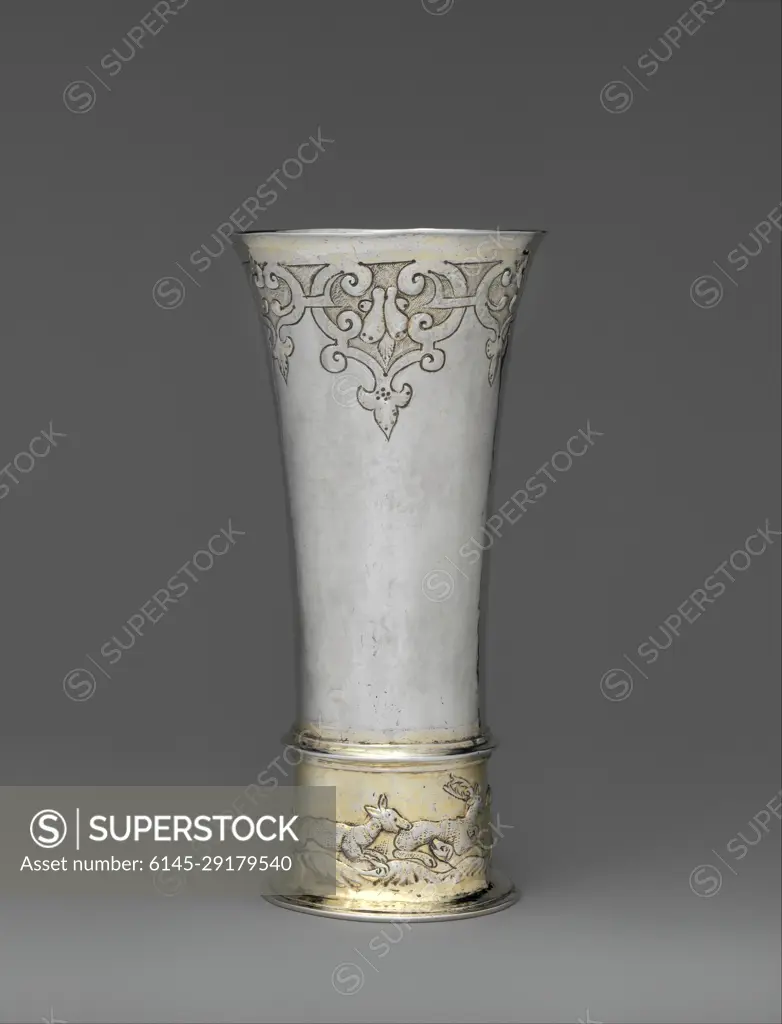
SuperStock offers millions of photos, videos, and stock assets to creatives around the world. This image of Footed beaker mid-17th century Possibly by Thomas Trepches II The proximity of Hungary to the Ottoman Empire may explain why Hungarian craftsmen and patrons often favored Oriental-inspired patterns, like the stylized arabesque scrollwork below the lip on this beaker, which had been out of fashion in Western Europe for almost two generations. The hunting scene at the base refers to the exclusive right of the local nobility to hunt certain game animals.LiteratureTihamér Gyárfás. A brassai ötvösség története. Brassó, 1912, p. 107, no. 179.Judit H. Kolba. Hungarian Silver: The Nicolas M. Salgo Collection. London, 1996, p. 66, no. 44.ReferencesA beaker with a similar foot was sold at auction by Dr. Fischer Kunstauktionen in Heilbronn.Elemér Kőszeghy. Magyarországi ötvösjegyek a középkortól 1867-ig / Merkzeichen der Goldschmiede Ungarns vom Mittelalter bis 1867. Budapest, 1936, possibly no. 203 maker’s mark.Wolfram Koeppe 2015. Footed beaker 237011 by Piemags/PL Photography Limited is available for licensing today.
Looking for a license?
Click here, and we'll help you find it! Questions? Just ask!
Click here, and we'll help you find it! Questions? Just ask!
DETAILS
Image Number: 6145-29179540Royalty FreeCredit Line:Piemags/PL Photography Limited/SuperStockCollection:PL Photography Limited Contributor:Piemags Model Release:NoProperty Release:NoResolution:2958×3869