Fist Shield 16th century Italian The shield is trapezoidal in outline and longitudinally convex in its median section, with the side edges slightly bent forward. It is reinforced around its edges with hammered turns and the semiglobular heads of the rivets, which once held the lining. A framework of six steel rods is riveted to the surface to stop and entrap an opponent's blade. The hook in the center could also serve this function, but its main purpose was for carrying the shield attached to a waist belt, with its grip on the outside ready to be grasped. The grip is secured by steel straps bridging the hollow of the median ridge.Since the thirteenth century, small round bucklers faced with steel had been used in sword fencing; when not in use they were usually hung from the belt or over the sword hilt. The quadrangular shield with a hollow mid-ridge is of eastern European origin, and appeared in the fourteenth century as the Lithuanian targe; originally these targes were of wood cover
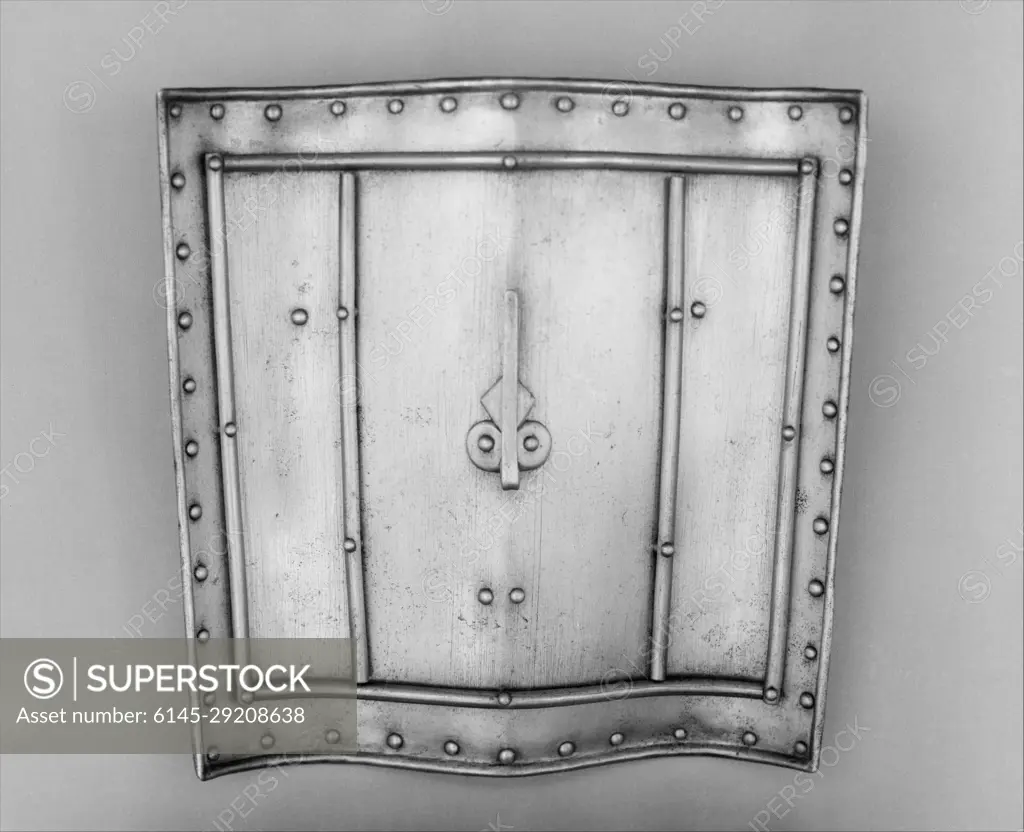
SuperStock offers millions of photos, videos, and stock assets to creatives around the world. This image of Fist Shield 16th century Italian The shield is trapezoidal in outline and longitudinally convex in its median section, with the side edges slightly bent forward. It is reinforced around its edges with hammered turns and the semiglobular heads of the rivets, which once held the lining. A framework of six steel rods is riveted to the surface to stop and entrap an opponent's blade. The hook in the center could also serve this function, but its main purpose was for carrying the shield attached to a waist belt, with its grip on the outside ready to be grasped. The grip is secured by steel straps bridging the hollow of the median ridge.Since the thirteenth century, small round bucklers faced with steel had been used in sword fencing; when not in use they were usually hung from the belt or over the sword hilt. The quadrangular shield with a hollow mid-ridge is of eastern European origin, and appeared in the fourteenth century as the Lithuanian targe; originally these targes were of wood cover by Piemags/PL Photography Limited is available for licensing today.
Looking for a license?
Click here, and we'll help you find it! Questions? Just ask!
Click here, and we'll help you find it! Questions? Just ask!
DETAILS
Image Number: 6145-29208638Royalty FreeCredit Line:Piemags/PL Photography Limited/SuperStockCollection:PL Photography Limited Contributor:Piemags Model Release:NoProperty Release:NoResolution:3873×3148