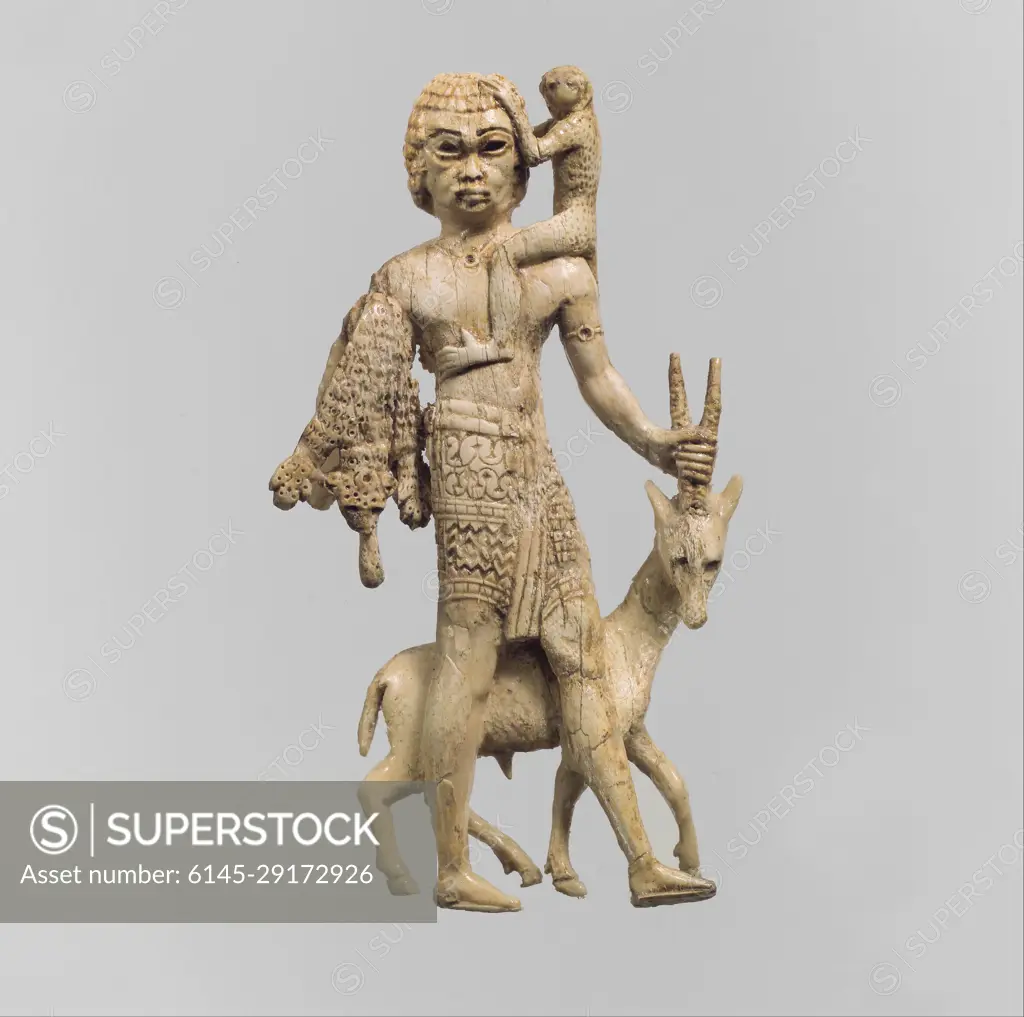
Figure of a man with an oryx, a monkey, and a leopard skin ca. 8th century B.C. Assyrian This statuette group, carved in the round, was found with five other statuettes with similar imagery. The six statuettes were excavated in and just below two arched niches built into the wall of a room at Fort Shalmaneser, a royal building at Nimrud that was probably used to store booty and tribute collected by the Assyrians while on military campaign. Those found just below the niches could have fallen when the palaces were destroyed during the the final defeat of Assyria at the end of the seventh century B.C. Originally, these objects were attached to long ivory plinths and exhibited in the arched niches, perhaps arranged in a procession of foreigners bringing different animals and animal skins as tribute to the Assyrian king. A frontally facing male, striding to the right with his lower body in profile, grasps the horns of an oryx (a species of desert-dwelling antelope) that strides behind him.
SuperStock offers millions of photos, videos, and stock assets to creatives around the world. This image of Figure of a man with an oryx, a monkey, and a leopard skin ca. 8th century B.C. Assyrian This statuette group, carved in the round, was found with five other statuettes with similar imagery. The six statuettes were excavated in and just below two arched niches built into the wall of a room at Fort Shalmaneser, a royal building at Nimrud that was probably used to store booty and tribute collected by the Assyrians while on military campaign. Those found just below the niches could have fallen when the palaces were destroyed during the the final defeat of Assyria at the end of the seventh century B.C. Originally, these objects were attached to long ivory plinths and exhibited in the arched niches, perhaps arranged in a procession of foreigners bringing different animals and animal skins as tribute to the Assyrian king. A frontally facing male, striding to the right with his lower body in profile, grasps the horns of an oryx (a species of desert-dwelling antelope) that strides behind him. by Piemags/PL Photography Limited is available for licensing today.
Looking for a license?
Click here, and we'll help you find it! Questions? Just ask!
Click here, and we'll help you find it! Questions? Just ask!
DETAILS
Image Number: 6145-29172926Royalty FreeCredit Line:Piemags/PL Photography Limited/SuperStockCollection:PL Photography Limited Contributor:Piemags Model Release:NoProperty Release:NoResolution:3802×3779